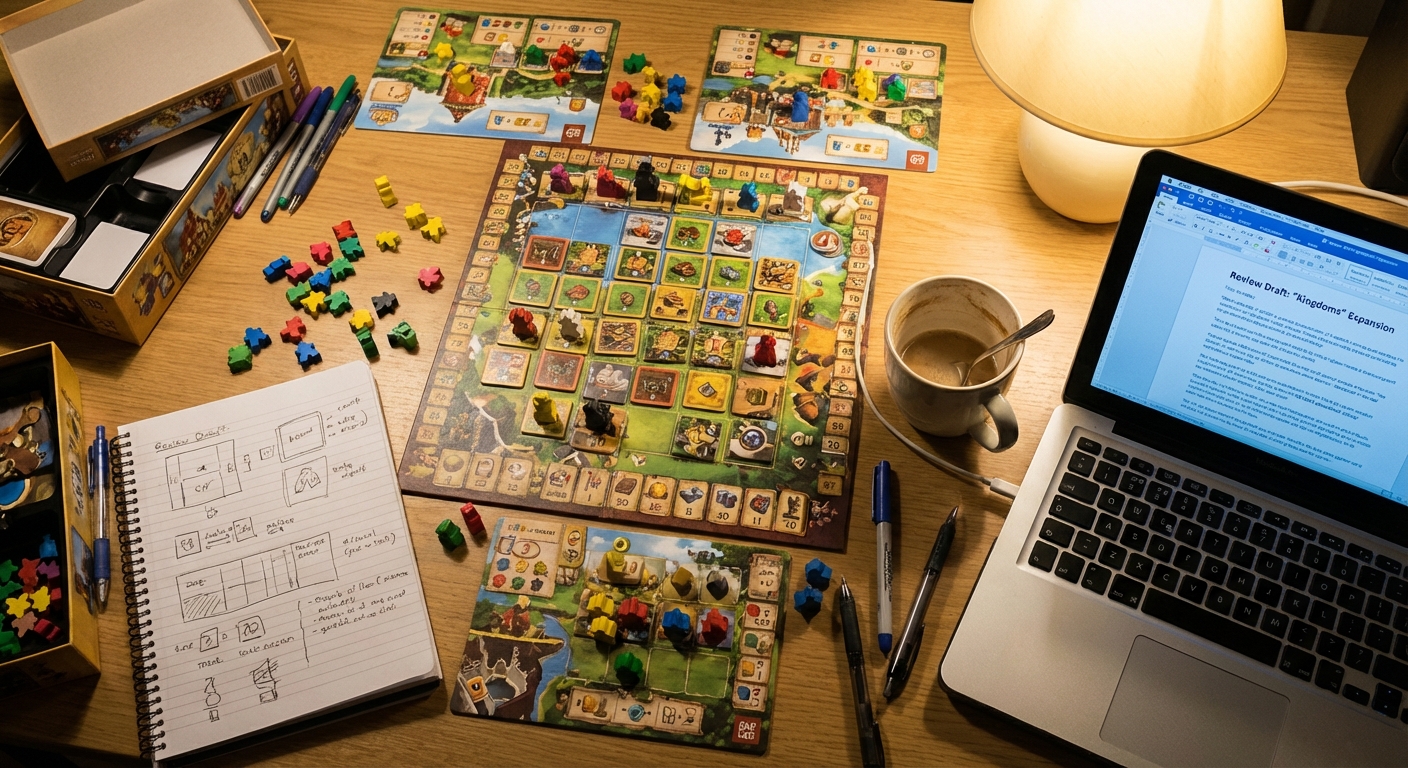
You’ve read that review: “Components are nice, art is great, it was fun, 8/10.” That tells you nothing about whether you, an experienced gamer with a shelf full of cardboard, should invest three hours and $70.
Why Most Board Game Reviews Leave Hobbyists Hungry
A great board game review isn’t a vibes check. It’s a tool—sharp, structured, and brutally useful.
Here’s the MeepleByte blueprint for a killer review that serves dedicated hobbyists, not just casual curiosity.
1. Hook: Define the Game’s Core Identity in One Punchy Line
If a review can’t explain what a game is in one sentence, everything else will be fuzzy.
Examples of sharp identity hooks:
- “A knife-fight-in-a-elevator area control game disguised as a civ-builder.”
- “A low-luck, engine-building euro that rewards ruthless tempo and punishes greed.”
- “A narrative co-op where loss teaches you more than victory.”
- What kind of fun is this? (tense, puzzly, chaotic, social, narrative)
- Who is it absolutely not for?
A killer review must answer up front:
Without that, the rest is noise.
2. Core Loop & Decision Space: What You Actually Do
Board gamers don’t need a rules overview—they need a decision overview.
2.1 Core Loop
Instead of explaining every phase, a strong review slices down to:
- On your turn you mostly… (draft, place, push, trade, play cards)
- You’re trying to… (convert X to Y efficiently, control zones, outpace others on tracks)
- You’re pressured by… (time, opponents, event deck, limited resources)
For example:
“In Lost Ruins of Arnak, your core loop is using a tight deck to generate resources just in time to explore, then parlaying that into artifacts and research. Every turn is a small efficiency puzzle under tempo pressure.”
2.2 Decision Space
A review for hobbyists should map:
- Breadth vs. depth – Many shallow choices vs. a few crunchy ones.
- Short-term vs. long-term tension – Tactical reactions vs. strategic arcs.
- Visibility – Perfect info vs. hidden info vs. chaotic randomness.
This is where you explain whether the game rewards planning, reading opponents, improvisation, or risk management—ideally with concrete examples.
3. Strategy Skeleton: How the Game Actually Fights Back
A bland review stops at “there are multiple strategies.” A sharp one outlines the strategic skeleton without becoming a full guide.
What to cover
- Primary scoring paths – Are there truly divergent routes or just different skins on the same math?
- Tensions and trade-offs – Economy vs. points, tempo vs. engine-building, safety vs. risk.
- Skill tests – Does the game test reading the table, long-term efficiency, bluffing, spatial planning?
Example:
“In Brass: Birmingham, you’re constantly torn between building infrastructure that pays off later and opportunistically leeching value from shared networks now. Mis-timing the canal/rail transition is a classic rookie mistake the game punishes harshly.”
This tells veterans: expect tempo pain and shared-incentive puzzles.
4. Interaction: Passive, Aggressive, or Psychological?
Interaction is where tables either light up or shut down.
Levels of interaction a review should map
- Indirect – Market competition, blocking spaces, racing tracks.
- Direct – Combat, targeted attacks, take-that effects.
- Psychological – Bluffing, negotiation, social reads.
- Can I ruin someone’s plan, or just beat them to the punch?
- Is conflict baked into the system or bolted on via attack cards?
- Does interaction scale cleanly with player count?
A killer review answers:
Example of good interaction analysis:
“Food Chain Magnate has no combat, but it’s one of the nastiest games on the market. You assassinate each other’s plans via timing and market cubes—if someone undercuts your restaurant, your whole engine can collapse.”
5. Component Quality: Function First, Bling Second
Dedicated gamers don't just want "pretty"; they want functional elegance.
Component notes that actually matter
- Icon clarity – Can new players parse state without constant rulebook dives?
- Board and card layout – Are key information and reminders where your eyes naturally land?
- Physical ergonomics – Are tokens easy to grab? Are minis overkill for what the game needs?
- Wear and tear – Thin tiles, weak inserts, and glossy boards under bright light.
Example:
“The dual-layered boards in Wingspan aren’t just fancy—they prevent cubes from sliding during midgame table bumps, which matters far more than the pastel bird art.”
Component analysis should end in a verdict: does the production support or fight the gameplay?
6. Pace, Downtime, and Cognitive Load
Hobbyists don’t fear complexity—but they hate slog.
What a strong review should specify
- Turn length feel – Snappy, medium, glacial.
- Downtime pattern – Evenly distributed or front/back-loaded.
- Analysis paralysis risk – Does decision density create AP landmines?
- Game length vs. perceived length – 2 hours that feel like 90 minutes is a win.
Example:
“Twilight Imperium is long, but rounds have a satisfying cadence. You’ll wait, but you’ll care what others do. Meanwhile, some heavy euros feel like tax returns after the first hour—crunchy but joyless.”
This is where you warn or reassure players with AP-prone groups or mixed attention spans.
7. The Honest Pros and Cons (No Fence-Sitting)
A MeepleByte-grade review calls its shots.
Pros should be
- Specific – “Brutally tight economy” not “good gameplay.”
- Useful – Highlight what the game does better than its peers.
- Unflinching – If the solo mode is an afterthought, say so.
- Contextual – Explain who will feel the pain and why.
Cons should be
Example structure:
Pros
- High skill ceiling with meaningful long-term planning.
- Interactive without overt take-that—perfect for competitive euros.
- Streamlined iconography after the first play drastically speeds turns.
- Punishing economy will tilt casual players.
- Box insert is useless for sleeved cards; setup drags without third-party help.
- First play is a "learn-to-lose" experience; not ideal for one-off demo nights.
Cons
8. Comparison Section: Place It in the Meta
Reviews for hobbyists should never exist in a vacuum.
Answer explicitly:
- If you like X, you’ll probably like this more/less because…
- Compared to Y, this is tighter/looser, harsher/softer, shorter/longer.
- “If Terraforming Mars feels bloated, this is the leaner, meaner cousin.”
- “If you adore Spirit Island’s puzzle but hate upkeep, this will feel like a downgrade.”
Examples:
Comparisons save readers hours of research and dozens of forum posts.
9. Verdict: Who Should Actually Buy This?
The final paragraph should not be: “Overall, we liked it.” That’s fluff.
Instead, a MeepleByte-style verdict specifies:
- Ideal audience – “Heavy euro players who enjoy shared incentives and punishing tempo.”
- Hard pass for – “Anyone who hates direct conflict or long-term planning.”
- Table constraints – “Shines at 3–4, falls flat at 2; needs a dedicated group.”
This is where you cash in all that nuance into a sharp recommendation.
Bringing It All Together
A killer board game review isn’t a hype reel; it’s a meta-tool for serious gamers. It:
- Defines the game’s core identity in one sharp sentence.
- Focuses on decision space, not rules recitation.
- Reveals the strategic skeleton and how the game punishes or rewards players.
- Details how and where players actually interact.
- Critiques components as tools, not trinkets.
- Assesses pace, downtime, and cognitive load honestly.
- Offers specific pros and cons without apology.
- Anchors the game in the larger hobby landscape.
- Ends with a clear, opinionated buying recommendation.
If a review hits all nine, you’re not just reading content—you’re wielding a finely honed buying guide. And if it doesn’t? Treat that glowing 9/10 with the skepticism it deserves.