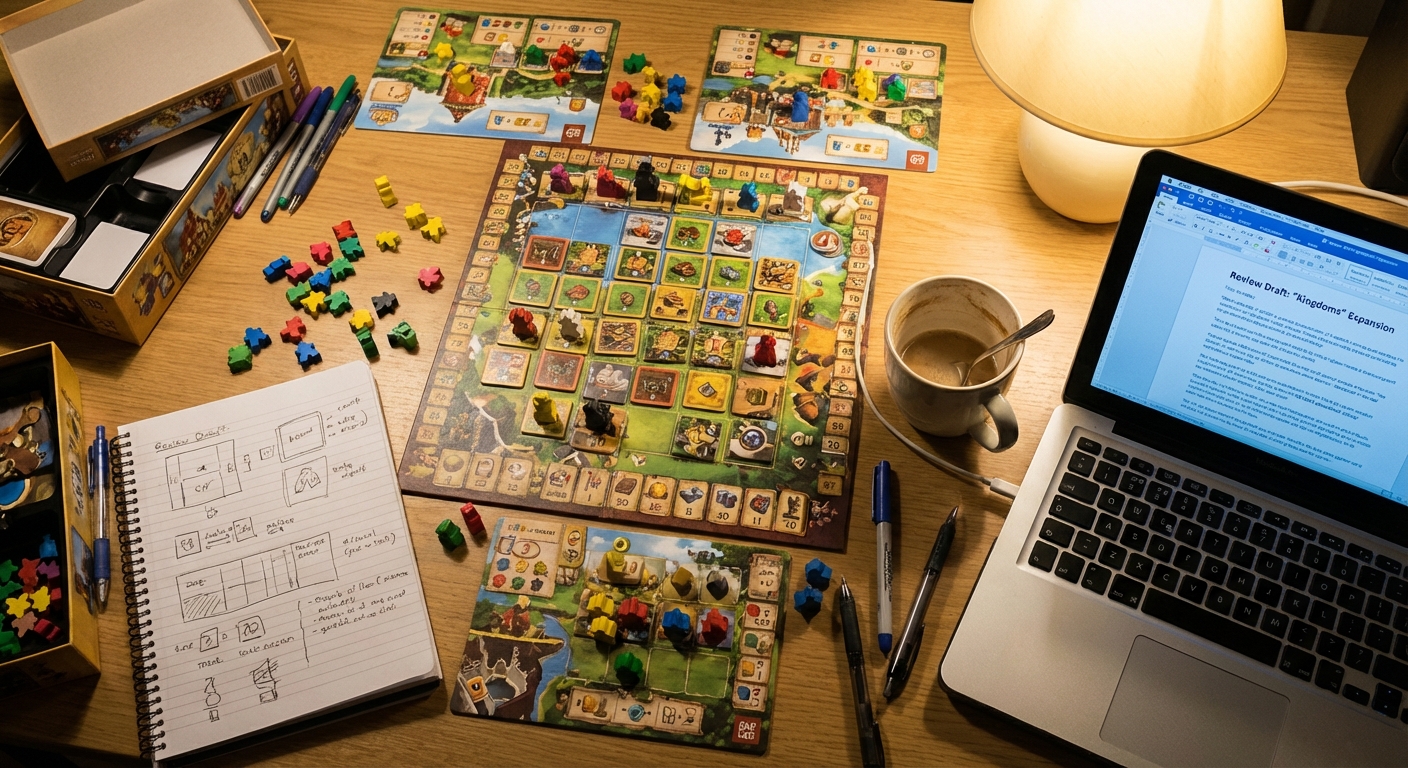
We’ve all done it: one flashy first play, a glowing post on social media, maybe even a rating. Then five more plays later, the shine has dulled—or the game has unexpectedly bloomed.
Your Opinion After One Play Is a Hot Take, Not a Review
For dedicated hobbyists, a static review based on 1–2 plays is like judging a campaign game from the tutorial scenario. Useful? Barely. Misleading? Absolutely.
Let’s break down how game reviews should evolve with play count—and how you, as a reader (or reviewer), can demand deeper, time-aware criticism.
Stage 1: First Impressions (1–2 Plays)
At this point, everything is surface-level. That’s fine—as long as it’s labeled as such.
What’s fair to judge
- Teach difficulty – How punishing was the learning curve?
- Rulebook quality – Did you spend half the night in FAQ limbo?
- Initial flow – Did turns make sense by midgame or still feel clunky?
- Component usability – Were icons, fonts, and layout helping or hindering?
- Long-term balance.
- Strategy depth and viable paths.
- True replayability.
What’s NOT fair to conclude
A responsible first-impressions review for hobbyists might say:
“We’ve played twice at 3 players. The iconography clicks by midgame, but scoring is opaque on the first pass. Too early to comment on balance, but early signs suggest at least two viable strategies.”
If a reviewer is already calling something “shallow” or “broken” after a single session, treat it as a mood, not a measurement.
Stage 2: Early Meta (3–7 Plays)
This is where serious commentary starts. Patterns emerge, strategies are tested, and the group begins to push on the design.
What reviewers should be analyzing here
- Opening theory – Are there clearly dominant early lines?
- Emerging strategies – Can different approaches actually win, or is it all one engine in disguise?
- Interaction patterns – Do players meaningfully collide, or drift into multiplayer solitaire?
- Learning curve – Are new players obliterated or can they compete with guidance?
Example of a strong early-meta insight:
“After six plays, we’ve seen rush, economy, and hybrid builds all win in Dune: Imperium. However, any line that ignores the intrigue card economy tends to get crushed, suggesting that axis is central to the game’s meta.”
This is where you can start trusting comments about:
- Viable paths to victory.
- Rough sense of player interaction.
- Early signs of replayability.
Stage 3: Mature Meta (8–20 Plays)
This is the review depth most hobbyists wish they got—but seldom do.
What becomes clear by this stage
- Strategic richness vs. solved patterns – Does the game keep surprising you, or are you going through motions?
- Real balance picture – Are there faction/map/card combos that dominate unless house-ruled?
- Group adaptation – Does the table naturally self-balance by attacking leaders, or does the design need patching?
- Pacing under mastery – As players optimize, does the game get snappier or bog down in hyper-AP?
- How opening moves have evolved.
- What common traps newer players fall into.
- Which advanced strategies emerged and whether they ruin or enrich the experience.
A mature-meta review should tackle:
Example:
“By our 15th play of Great Western Trail, the illusion of many strategies narrowed. Ignoring the cattle economy is fantasy; real depth lies in how you balance deck-thinning vs. tempo vs. building investments. Replay value remains high because the tension between those three dials never resolves cleanly.”
Now you have actionable insight about depth, not just first-play thrills.
Stage 4: Longevity & Shelf Life (20+ Plays or a Full Year)
At this point, you’re qualified to talk about staying power—the axis most early reviews simply guess at.
What a long-haul review should cover
- Rotation reality – How often does this actually hit the table now?
- Fatigue factors – What parts feel repetitive, scripted, or tedious?
- Expansion dependence – Did later content fix core issues or just bloat the system?
- Role on the shelf – What did it replace, and what replaced it?
This is where the honest takes live:
“We were obsessed with Scythe for six months. After 20+ plays, the scripted openings and predictable tempo kills started to show. We still respect the design, but it’s now a ‘teach-to-new-people’ game, not a mainstay for our core group.”
Or:
“Root survived brutal testing. Different factions, maps, and player skill levels kept the meta churning. 25 plays in, we’re still debating optimal lines for the Vagabond. This one earned permanent shelf space.”
Long-haul reviews separate crushes from keepers.
How Readers Should Weigh Play Count in Reviews
When consuming reviews, don’t just scan the score—scan the experience base.
Ask:
- How many plays? At what counts? With what skill levels?
- Are they clear about which stage they’re in (impressions, early meta, mature meta, longevity)?
- Do their complaints feel like first-time friction or deep design flaws?
- 1–2 plays: Good for components, teach feel, and initial vibe. Use with caution.
- 3–7 plays: Solid for strategy sketching, interaction density, and pacing.
- 8–20 plays: Strong for depth, balance, and emergent meta.
- 20+ plays / 1 year: Gold standard for longevity and shelf value.
Rough weighting for serious hobbyists:
How Reviewers Can Level Up Their Own Content
If you write reviews (formally or on forums), structure them to reflect time:
- Label your stage – Call it “First Impressions,” “After 10 Plays,” etc.
- Revisit scores – Adjust ratings as your meta matures; be transparent.
Add a meta section – What changed between early and late plays?
Track group skill – Did your opinions shift as everyone improved?
Example review structure:
- First Impressions (2 plays): Highlight rules friction, flow, component usability.
- After 6 Plays: Discuss emerging strategies, interaction, and perceived balance.
- After 15 Plays: Address depth, fatigue, dominant strategies, and table appetite.
This not only makes your content more honest—it makes it invaluable to hobbyists.
The Punchline: Time Is the Missing Axis in Most Reviews
Most board game reviews act like opinions are static. They’re not. Games change as:
- Players improve.
- Strategies solidify or collapse.
- Novelty wears off and only the core loop remains.
- Separate “this was fun tonight” from “this is worth owning for years.”
- Treat early hot takes as trailers, not final cuts.
- Put the number of plays and months on the table alongside the score.
When you read (or write) a review, demand time-aware criticism:
Only then can reviews actually answer the question serious hobbyists care about most:
Not “Is this good?” but “Is this still good after 20 plays?”