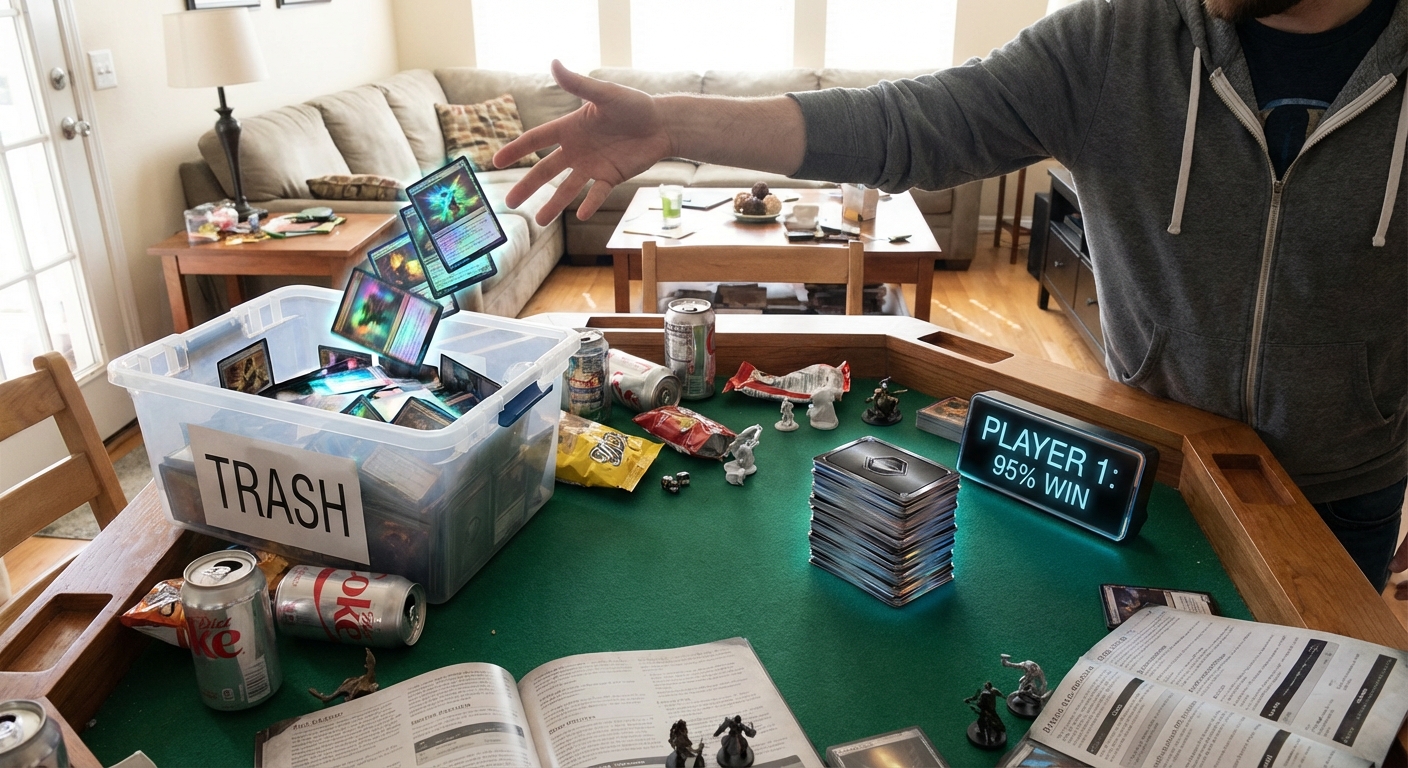
Deck-building looks chaotic on the surface—market rows shifting, players buying random combos, rules text everywhere. Underneath that chaos, there’s structure. Most successful decks fall into a handful of recognizable archetypes.
Archetypes: The Secret Language of Deck-Builders
Once you can name an archetype, you can:
- Build it faster.
- Counter it smarter.
- Avoid half-baked ideas that do a bit of everything and nothing well.
Let’s break down five core archetypes you’ll see across games like Dominion, Clank!, Aeon’s End, Star Realms, Dune: Imperium, and beyond.
1. The Thin Engine
Core idea: Trash almost everything, overdraw your tiny deck, repeat disgusting turns.
What It Looks Like
- Heavy trashing early (remove starters, curses, junk).
- Lots of draw, some +actions or chaining.
- A small set of high-impact cards you see every turn.
Think Dominion with Chapel + Village + Smithy, or Aeon’s End with a loop of efficient spells and charge generation.
Strengths
- Hyper-consistent: Few dud turns.
- Explosive endgame: Once online, every turn feels like a fireworks show.
- Incredible tactical flexibility: You see most of your deck every shuffle.
Weaknesses
- Slow start: You sacrifice early scoring to build infrastructure.
- Vulnerable to rush: If opponents push an early end, you may never fully come online.
- Reliant on trashing availability.
When to Play It
- The game offers strong trashing and good draw.
- The game length is predictable or slightly long.
- Opponents aren’t clearly rushing.
2. The Fat Value Stack
Core idea: Don’t obsess over trashing. Just keep scoring and buying high-value cards; let raw power carry you.
What It Looks Like
- Modest or no trashing.
- Solid economy buys every turn.
- Occasional big payload grabs (points, damage, VP cards).
This is common in Star Realms and Clank!—you buy high-impact cards and accept a thicker deck, trusting sheer card quality.
Strengths
- Simple, reliable game plan.
- Strong early and midgame presence.
- Resilient in chaotic markets where tight engines are hard to assemble.
Weaknesses
- Inconsistent hands: Some turns explode; others whiff.
- Loses to well-built engines in longer games.
- Harder to leverage subtle synergies.
When to Play It
- Trashing is weak, overly conditional, or absent.
- The market is full of strong stand-alone cards.
- Players are attacking each other, making fancy engines fragile.
3. The Rush / Tempo Aggro
Core idea: Score or damage quickly before slower strategies can stabilize.
What It Looks Like
- Minimal deck manipulation; focus on fast-scoring or early aggression.
- Buys that immediately convert to progress (VP, damage, objectives).
- Often ignores late-game scaling.
In Dominion, this might be a rush on Duchies or alt-VP (Gardens, Silk Road). In Star Realms, a hyper-aggressive damage deck that scrapes out a win before the opponent’s engine stabilizes.
Strengths
- Punishes greedy and slow engine builds.
- Straightforward decision-making.
- Forces others to respond to your timetable.
Weaknesses
- Runs out of steam if the game goes long.
- Vulnerable to life gain, defense, or tempo resets.
- Can be fragile if early buys stumble.
When to Play It
- The game offers fast, early scoring paths.
- Opponents are clearly going for big, late-game engines.
- The clock (boss deck, VP pile, dungeon depth) is short.
4. The Combo Machine
Core idea: Build around specific card interactions for absurd payoff turns.
What It Looks Like
- Key synergies: "When you play X, Y triggers" or "Copy Z" or "Gain a card to top of deck."
- Cards that are mediocre alone but broken together.
- Turns where your deck essentially plays itself once the combo starts.
Examples:
- Dominion: Throne Room + King’s Court + draw chains.
- Aeon’s End: Spells that recur themselves or each other.
- Clank!: Cards that chain off each other’s keywords.
Strengths
- Absolutely bonkers ceiling when the combo fires.
- Deeply satisfying to pilot.
- Can win from behind with a couple of monster turns.
Weaknesses
- Inconsistent if piece acquisition is slow.
- Highly dependent on market row luck.
- Telegraphed—opponents may deny key pieces.
When to Play It
- The game has obvious, supported combos in the supply.
- You can grab enablers early before others notice.
- You’re comfortable accepting high variance for high reward.
5. The Control / Denial Deck
Core idea: You’re not just building your deck—you’re actively crippling everyone else’s.
What It Looks Like
- Attacks, hand disruption, market denial.
- Cards that add junk to opponents’ decks.
- Gains that matter more for what opponents don’t get.
In Dominion, think of Curse-givers plus trashing for yourself. In Dune: Imperium, hate-drafting specific agents or cards to block power combos.
Strengths
- Drags rush and value decks down to your pace.
- Magnifies your small advantages (your lean deck vs. their junked one).
- Devastating in low-player-count games where each attack hits hard.
Weaknesses
- Slower personal development if you over-invest in attacks.
- Often weaker in high player-count games (attacks dilute across more targets).
- Can create a miserable experience if overdone—expect table politics.
When to Play It
- Attack cards are genuinely strong, not just annoying.
- You have access to self-trashing/thinning to stay ahead.
- The table is racing; slowing everyone else is as good as speeding yourself up.
Reading the Table: Matching Archetype to Context
Choosing the right archetype is half the game. Ask:
- What does the market offer? Strong trashing = engine; heavy attacks = value or control.
- How does this game end? Short clocks favor rush; long arcs reward thin engines and combos.
- What are others doing? If everyone’s building engines, a focused rush or control plan can feast.
Don’t force archetypes that the supply can’t support. If the only draw is weak and trashing is nonexistent, your dream thin engine isn’t happening.
Component Quality and Archetype Clarity
Here’s a subtle point: good component and graphic design makes archetypes more readable.
- Clear card types and icons help you spot enablers at a glance.
- Keyword consistency exposes combo potential.
- Clean layouts make it easy to evaluate tempo (cost vs. impact) mid-game.
Games that fumble iconography or bury rules text in lore-fluff actively obscure archetypes, making strategic play a chore instead of a joy.
Leveling Up: Practice One Archetype at a Time
If you want to get sharper:
- Play a few sessions where you force yourself into a thin engine whenever the supply barely allows it. Learn its pain points.
- Next, try rush in situations that seem “borderline” and see how often you can steal a win.
- Then, dedicate a night to hunting combos, even at the cost of consistency.
The goal isn’t to lock into one style; it’s to build an internal library so that when you glance at the market row, you immediately think, “Ah, this is a rush game,” or “This is an engine playground.”
Once the archetypes click, you’ll stop building random piles of cards and start piloting coherent strategies. That’s when deck-building really opens up.