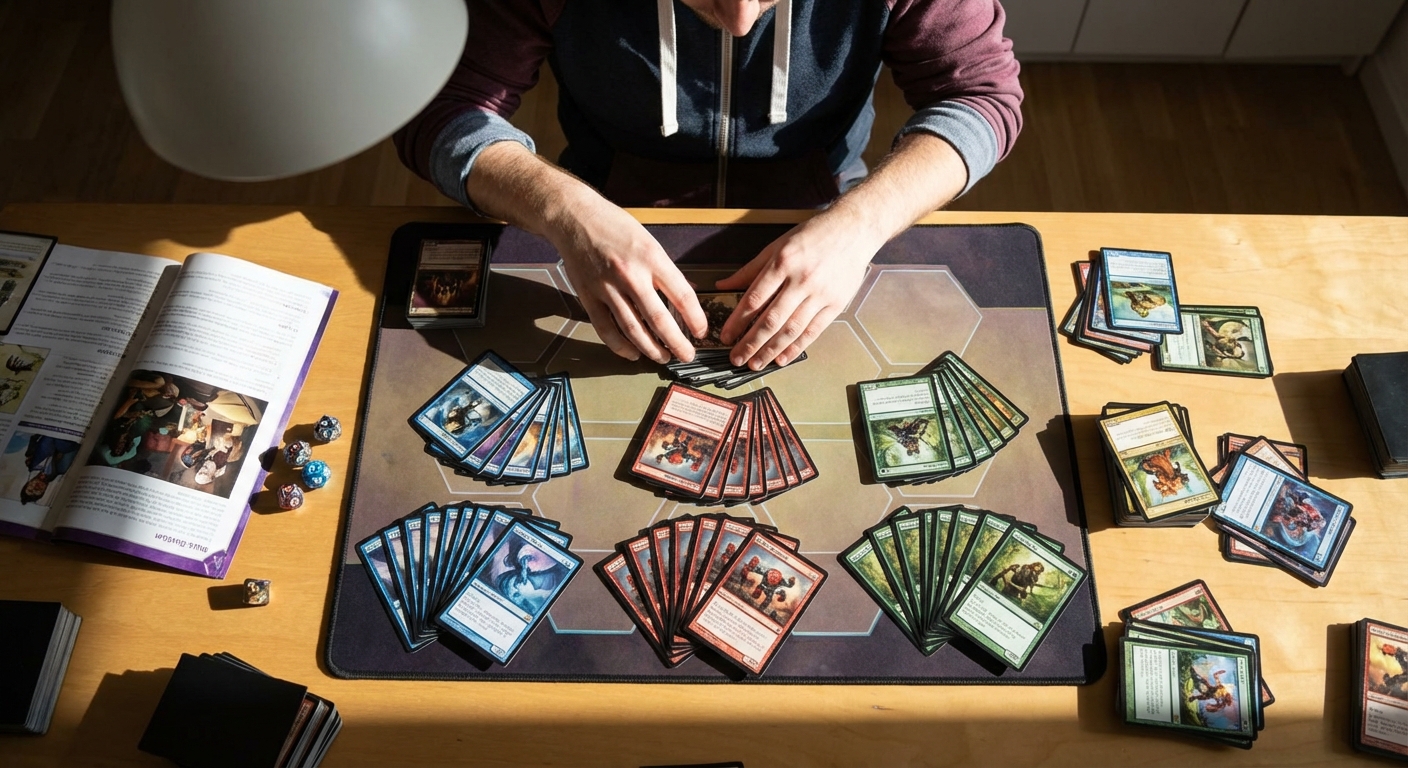
If you’ve ever ended a game thinking, “My deck never really worked,” this is for you. Deck-builders are engines disguised as card games, and most players only half-build the engine before the game ends.
Deck-Building, Under the Knife
Let’s crack open a generic deck-builder and slice it into pieces: economy, draw, trashing, tempo, and scoring. We’ll reference classics like Dominion, Aeon’s End, Clank!, and Dune: Imperium, but the logic holds for nearly any deck-building design.
Core Component #1: Your Economic Spine
Your spine is the part of the deck that reliably generates the resources you need each turn—coins, power, crystals, persuasion, whatever.
What a Good Economy Looks Like
- Consistent: You can practically predict your minimum spend most turns.
- Scalable: It grows over time without becoming dead weight.
- Integrated: It doesn’t clog your deck with single-use or low-impact cards.
In Dominion, Silver/Gold are the most basic example—consistent, but not scalable without support. In Aeon’s End, certain crystals give you ongoing deck manipulation, turning economy into long-term advantage.
Diagnosis: If you often have “sad turns” where your hand can’t do anything interesting, your economic spine is either too weak or too inconsistent.
Core Component #2: Draw and Filtering – The Nervous System
Draw and filtering are how you actually access your deck. They’re the nervous system connecting your components.
Draw Power: The Double-Edged Sword
More draw is usually good, but only if:
- Your deck already has something worth drawing into.
- You manage your reshuffle timing.
- You’re not just drawing junk faster.
In Clank!, cards that draw and also add Clank are seductive but risky: you’re cycling faster at the cost of more dragon pulls. Strong players calibrate how much risk their life total can handle.
Filtering: Quietly Broken
Sifting cards ("draw 2, discard 1," "look at top 3, pick 1") is incredibly powerful because it increases consistency without bloating your deck.
In Aeon’s End, the lack of shuffling plus top-of-deck manipulation creates disgusting levels of control in the hands of a careful player.
Diagnosis: If your turns feel wildly swingy—one massive, one pathetic—you probably need better draw/filtering to smooth variance.
Core Component #3: Trashing – The Surgeon’s Scalpel
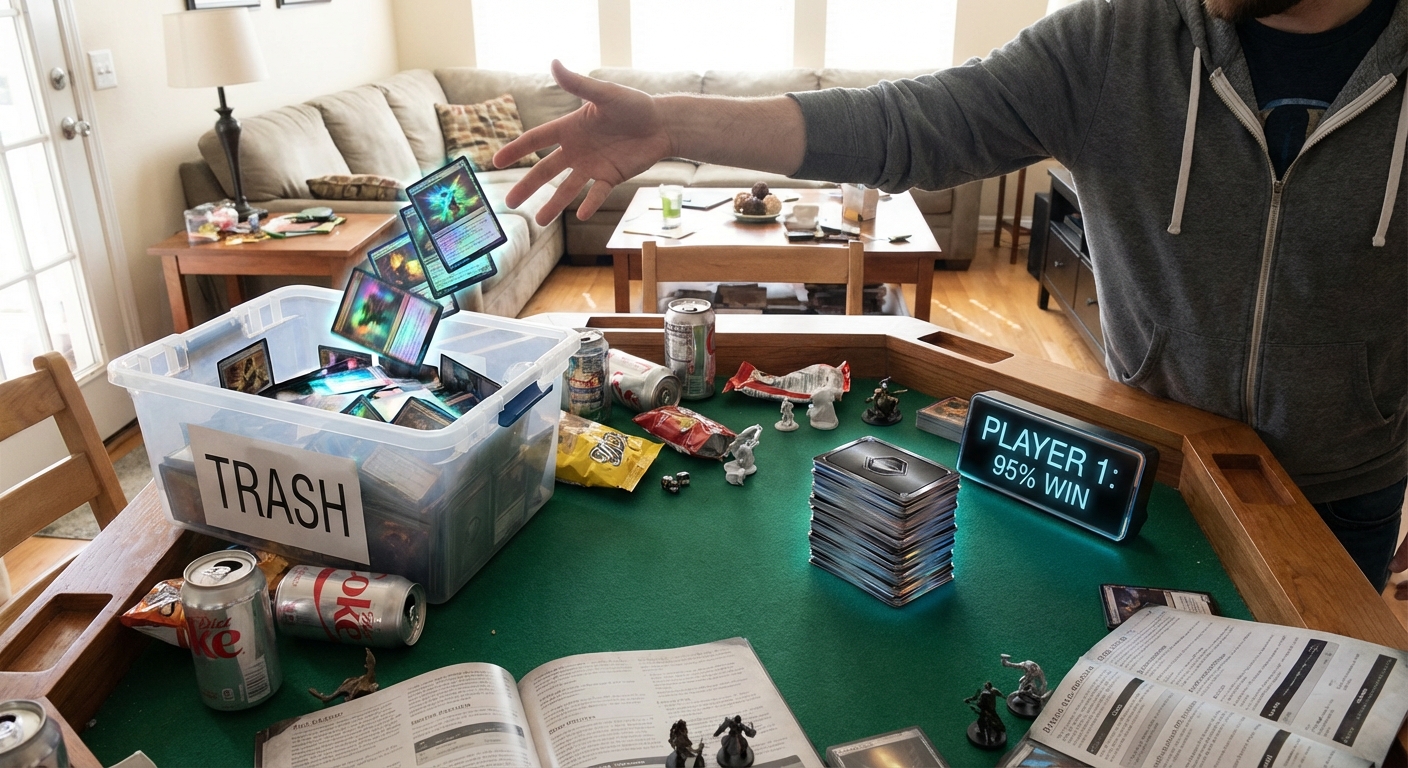
Trashing is the scalpel that turns a messy card pile into a purposeful engine.
Trashing Types and How They Shape the Game
- Fast, brutal trashing (e.g., Dominion’s Chapel): Rewards razor-thin, high-skill engines.
- Slow, conditional trashing: Forces tough timing and opportunity-cost decisions.
- Pseudo-trashing (burying, exiling, removing until game end): Still excellent if it keeps junk out of circulation.
The earlier you start trashing, the more times you reap the benefit of a thinner deck. Waiting “until later” is a fancy way of saying “I like playing in hard mode.”
Diagnosis: If your end-game deck looks like your start deck plus a handful of good cards, you underused the scalpel.
Core Component #4: Payload – The Muscles
All the economy, drawing, and trashing in the world is pointless if you don’t convert it into actual victory.
Payload is:
- Points (victory cards, artifacts, objectives)
- Damage (player elimination, boss health, Nemesis HP)
- Tempo hits (discard attacks, resource denial, VP swings)
In Dune: Imperium, your payload is a mix of victory points and combat strength swings. In Star Realms, it’s damage and authority manipulation.
Timing Your Pivot to Payload
Engines lose games when they pivot too late. Rush decks lose games when they pivot too early.
Ask yourself each turn:
If I add one more engine piece now, how many times will I realistically use it before the game ends?
If the answer is fewer than 2–3 meaningful uses, it’s probably time to slam payload.
Diagnosis: If by the end of the game you have a gorgeous engine that never got to actually score big, your pivot window passed you by.
Core Component #5: Tempo and the Game Clock – Heartbeat
Every deck-builder has a heartbeat: reshuffles, market refills, boss decks, VP pile depletion, player damage thresholds.
Reading the Clock
- In Dominion: Watch the Province pile and cheap piles that could easily three-pile.
- In Aeon’s End: Track the Nemesis deck and Gravehold’s health.
- In Clank!: Internalize how close players are to triggering the end game (and how safely you can push).
Your deck’s design should match the speed of the clock:
- If the game clock is short and vicious: Prefer compact, low-setup strategies.
- If the game clock is long or controllable: Justify deeper, more intricate engines.
Diagnosis: If your deck always seems “one cycle away” from greatness when the game ends, you misread how fast the game would close.
Synergy vs. Bloat – The Immune System
Every deck-builder tries to trick you into overbuying. Not every synergistic-looking card is a good add.
Spotting False Synergies
- Shares keywords but not timing (clunky combo).
- Shares faction but not function (on-theme, off-plan).
- Looks good in isolation but does nothing toward your win condition.
In Legendary: A Marvel Deck-Building Game, it’s common to chase “cool hero combos” that never quite line up. Strong players buy for tactical purpose, not lore flavor.
Rule: If a card doesn’t make your best turn better or more frequent, it’s probably bloat.
Component Quality: When Physical Design Helps (or Hurts) Strategy
Great component design turns complex decision spaces into something playable.
What Good Deck-Builder Production Looks Like
- Readable at a glance: Cost, type, and core effect in predictable places.
- Durable: Deck-builders are shuffle monsters; cheap stock is a crime.
- Thoughtful iconography: Repeated actions (draw, gain, trash, attack) get clear and consistent icons.
Games like Dune: Imperium and Aeon’s End understand that clarity is power. Poor iconography and cluttered art slow the game and obscure probability calculations.
Sleeves, decent inserts, and card dividers aren’t luxury upgrades; they’re ergonomic tools for players who want to think about strategy, not storage.
Running a Post-Mortem on Your Deck
After any deck-building game, do a quick 2-minute debrief with yourself or the table:
- What was my deck trying to do? (Be specific.)
- When did that plan actually come online? (Turn/round number.)
What card purchases didn’t serve that plan?
Did I misread the game clock? How?
This habit sharpens your internal sense of tempo and synergy far faster than playing mindlessly.
Final Cut: Think Like a Surgeon
Stop building “good stuff” piles and start building coherent engines:
- Spine: Reliable economy.
- Nervous System: Draw and filtering.
- Scalpel: Aggressive trashing.
- Muscles: Focused payload.
- Heartbeat: Tempo matched to the game’s clock.
- Immune System: Resistance to bloat and false synergy.
The next time you sit down to a deck-builder, don’t just ask, “What can I buy?” Ask:
What part of my engine am I operating on this turn—and am I sure I’m not just adding more organs to a corpse?
That's how you graduate from spectator to surgeon at the deck-building table.