Most people “try” solo gaming once, bounce off a 40-minute rules slog, and assume it’s not for them. The secret isn’t just what you play; it’s how you build solo gaming into your life so it feels like a ritual, not a chore.
Solo Play as a Ritual, Not a One-Off
This is a practical, step-by-step guide to turning solo play into a sustainable habit: from choosing the right games and organizing components to mindset, difficulty, and avoiding burnout.
Step 1: Start with the Right Kind of Game
If your first solo attempt is a 3-hour table hog with a 40-page rulebook, that’s user error.
Aim for:
- Playtime: 30–60 minutes for a single session
- Setup: Under 10 minutes
- Rules density: You can teach yourself from scratch in under an hour
Good starting categories
- Dedicated solo games: Under Falling Skies, Sprawlopolis, Final Girl
- Low-interaction Euros with official solo mode: Wingspan, Hadrian’s Wall, Ark Nova (once you’re comfortable)
- Co-ops with clean AI: Aeon’s End, Marvel Champions, Pandemic (with solo tweaks)
- Giant campaign games that demand 10+ hours before they get good
- Solo variants that require running 2+ bots in parallel
Avoid at first:
Step 2: Embrace “Learning Plays” Without Guilt
Your first few plays of any solo game are tuition, not performance.
Practical approach:
- Skim, then play: Read setup + first few turns, then play with the rulebook open.
- Allow rewinds: In solo, you’re both judge and jury. Rewind turns when you misread a rule early on.
- Tag the rulebook: Use sticky tabs for: Setup, AI turn, End of round, FAQ.
Mindset shift: You’re not “bad” at the game; you’re paying the learning tax upfront so future plays can be smooth and satisfying.
Step 3: Create a Solo-Friendly Setup Space
If you have to clear your entire dining table and unbox six expansions just to play, you’ll play less.
Optimize your battlefield:
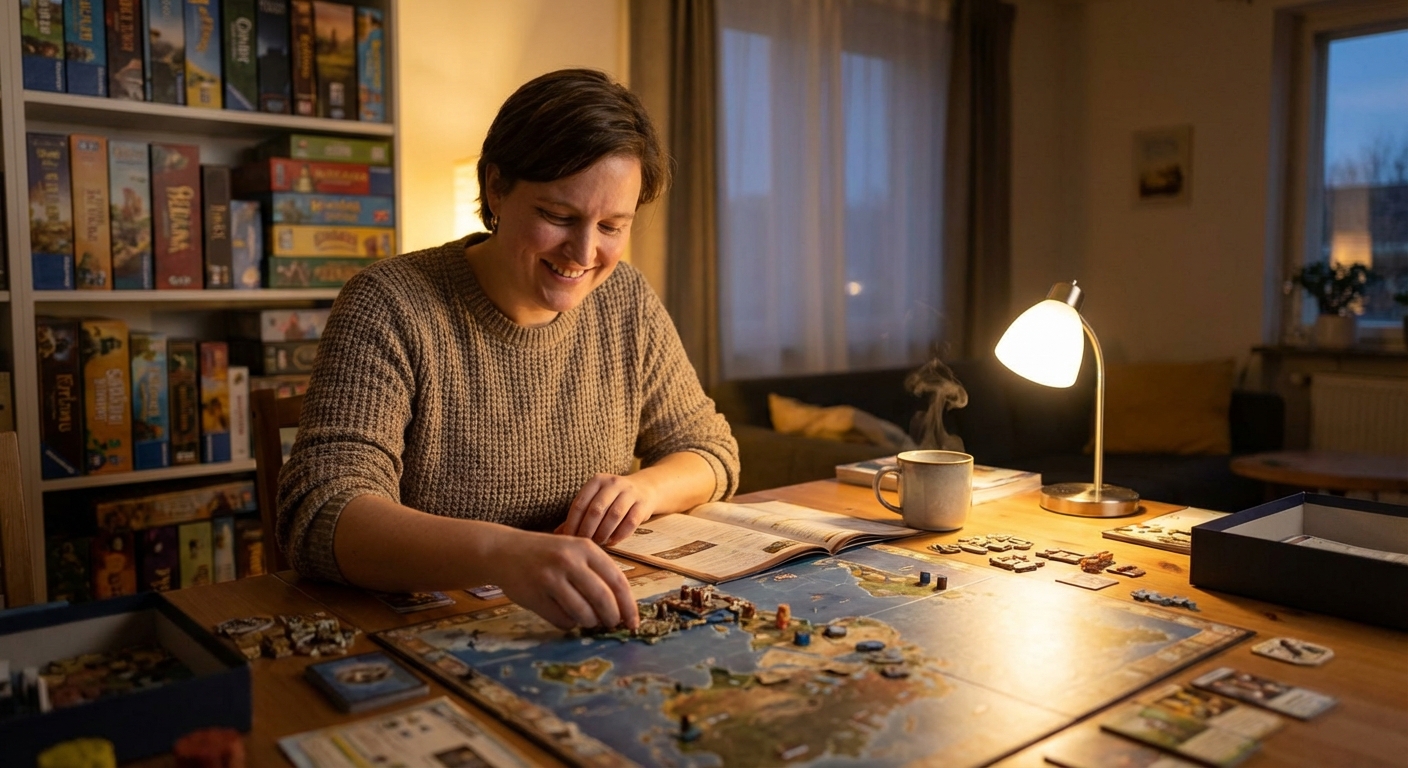
- Dedicated corner: Even a small side table can host microgames and compact Euros.
- Storage near the table: Keep 3–5 solo staples in arm’s reach.
- Organizers matter: Inserts, bags, and trays cut setup/teardown drastically.
Component considerations for solo:
- Choose games with clear iconography; you don’t want to re-check references every card.
- Prefer dual-layer boards and strong contrast if you play at night or in low light.
- Use a playmat or table cover to keep tiles and cards from creeping around.
Turn your solo space into a low-friction zone: you should be able to go from “I feel like a game” to “first turn taken” in under 10 minutes.
Step 4: Build a Weekly Solo Schedule (That You’ll Actually Keep)
You don’t need a Gantt chart; you need consistency.
Simple weekly structure
- One “focus night” (60–120 min): Deep dive into a heavy game or campaign.
- Two micro-sessions (20–40 min): Quick puzzles or short scenarios.
- Tue: 30 minutes of Sprawlopolis or Res Arcana solo
- Thu: 90-minute Spirit Island or Aeon’s End session
- Sun: 20-minute cleanup scenario or lighter game
Example:
Adjust for your life, but keep solo gaming as a recurring appointment with yourself.
Step 5: Use Difficulty as a Tool, Not an Ego Trap
Solo modes often offer:
- Scenario tiers
- AI difficulty knobs
- Optional challenge modules
Smart difficulty management
- Start at “Normal,” not “Hardcore Hellfire.” Let the game breathe.
- If you win comfortably 3+ times, bump difficulty.
- If you lose 3 times in a row without feeling you learned anything, drop difficulty or remove a module.
- ~40–60% win rate in tactical puzzle games
- ~20–40% win rate in swingy narrative games
You’re aiming for:
The goal isn’t public bragging rights. It’s getting into that sweet spot of tension where every decision matters.
Step 6: Track Just Enough to Learn, Not to Obsess
You don’t need a spreadsheet empire (unless you want one). A simple log turns random games into a visible personal meta.
Log basics:
For each play, jot down:
- Game & scenario
- Difficulty
- Result & score
- One thing you did well
- One mistake you want to avoid next time
- “I always undervalue card draw.”
- “I ignore long-term scoring in favor of short-term safety.”
That last line is where the magic is. Over a month you’ll see patterns:
That insight makes later plays more satisfying.
Step 7: Rotate Your Solo Roster Intentionally
Burnout happens when you hammer the same game without giving your brain a palate cleanser.
Build a small, sharp solo roster
Aim for 4–8 games that cover:
- Quick, low-setup puzzle: Sprawlopolis, Onirim, Cascadia
- Mid-weight tactical: Under Falling Skies, Hadrian’s Wall, Marvel Champions
- Heavy thinky beast: Spirit Island, Ark Nova, Lisboa (with solo)
- Narrative/campaign: Final Girl, Gloomhaven, ISS Vanguard (if you’re committed)
Cycle them so no single title becomes a grind.
Step 8: Lean Into Multihanding (When It Makes Sense)
Many co-ops assume 2–3 players. In solo, that means you might need to control multiple characters.
When multihanding works:
- Clear turn structure: (e.g., Gloomhaven, Aeon’s End)
- Distinct roles: Characters that bring different tools to the problem
Tactics for sanity:
- Use separate colored tokens or trays for each character
- Physically separate boards so you can scan quickly
- Give each character a quick one-sentence role: “Tank,” “Healer,” “Control,” etc.
If it feels like running an HR department, reduce character count or pick a different game.
Step 9: Give Yourself Permission to Quit Mid-Campaign
Campaign FOMO is real. But slogging through a 40-scenario campaign you’re no longer enjoying is a fast track to hating solo.
Healthy mentality:
- You do not owe your cardboard closure.
- If setup dread outweighs excitement twice in a row, shelve it.
- Is the game genuinely not fun solo?
- Am I burnt out on this genre right now?
Before quitting, ask:
Sometimes the answer isn’t “sell it”; it’s “come back in three months with fresh eyes.”
Step 10: Make It Social (On Your Terms)
Ironically, solo gaming doesn’t have to be lonely.
Ways to share:
- Post session logs or photos on BGG or Discord.
- Join solo-specific communities (r/soloboardgaming, various Discord servers).
- Try async challenges: same scenario + difficulty, compare scores.
This keeps the hobby vibrant without giving up the best part of solo: total autonomy.
Final Thoughts: Your Time, Your Tempo
A strong solo gaming habit isn’t about grinding the heaviest titles to prove something. It’s about:
- Picking games that actually respect solo players
- Reducing friction in setup, rules, and storage
- Tuning difficulty and variety so your brain stays engaged
Turn solo gaming from “emergency backup plan” into a weekly ritual you actively look forward to. Once that happens, you’ll stop asking, “Is this worth playing solo?” and start asking a better question:
“Which game gets the honor of my table tonight?”