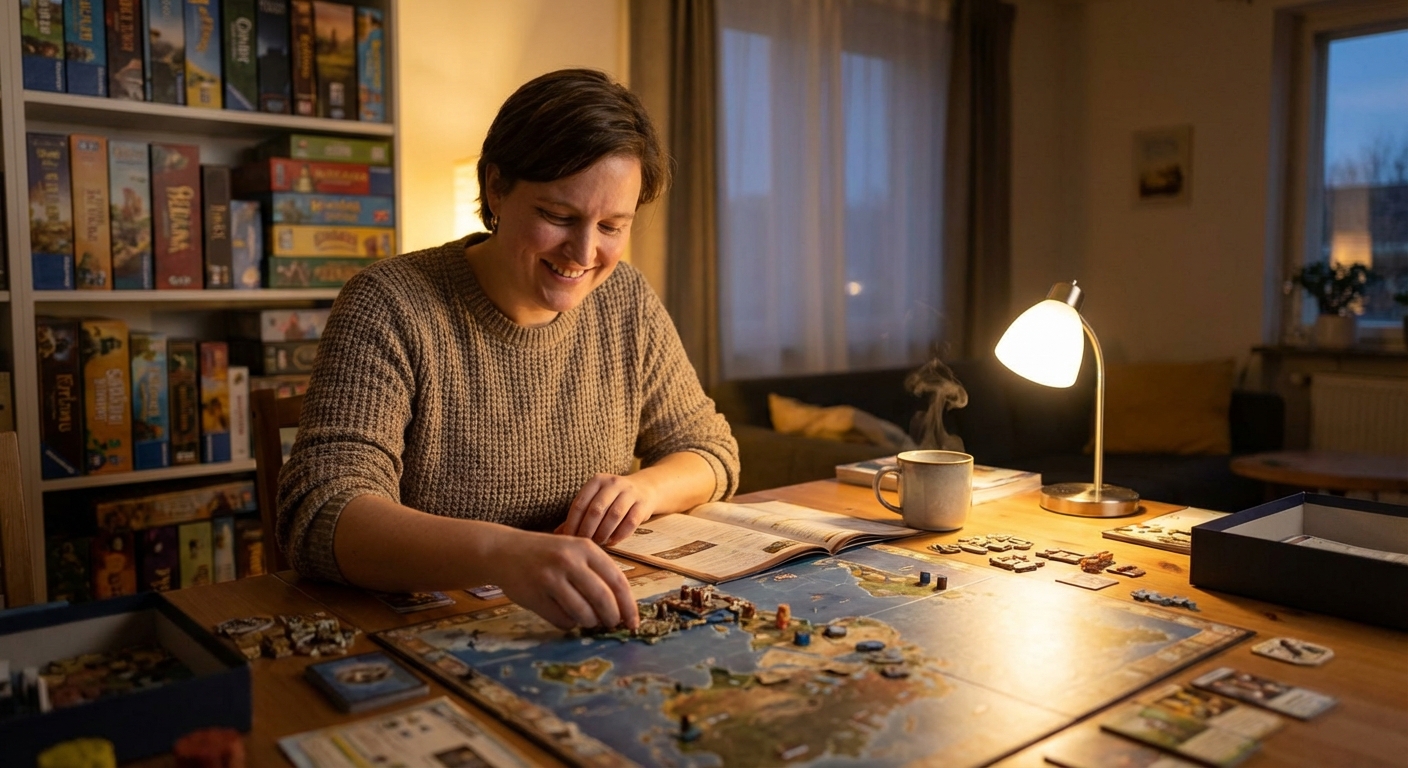
A lot of boxes print "1–4 players" because marketing said so, not because the design team deeply cared about the solo experience. This list is different: these are 10 games that not only work solo, but might be at their absolute best there.
Why Some Games Sing Solo
You’ll get:
- A breakdown of what makes each game click alone
- Strategy angles specific to solo
- Component notes that matter when you’re running the entire show
- Honest pros and cons from a dedicated solo-first mindset
1. Under Falling Skies
A compact, campaign-ready dice placement defense puzzle.
Why it shines solo: It’s born solo. No automa, no fake players, just you, your base, and a relentless mothership.
Core solo tension:
- Every die you place helps and hurts you (higher value = stronger action + faster alien descent)
- Your health, energy, and research track are always in a knife fight
Strategy tip: Prioritize research pacing. Don’t overinvest in defense early; a slow research track is a quiet loss condition.
Component notes:
- Compact board, thick tiles, clear iconography
- Campaign content layered via modular city and scenario cards
Pros: Fast setup, strategic depth in 30–45 minutes, excellent progression.
Cons: Abstract theme for some, dice luck can sting if you don’t lean into mitigation.
2. Spirit Island
A heavyweight co-op anti-colonial defense game that goes full spreadsheet in the best way.
Why it’s better solo: Multi-handed solo removes table discussion bloat; you can run 2–3 spirits with perfectly synchronized plans.
Core solo tension:
- Managing fear generation vs. immediate defense
- Timing major power spikes against the invader card reveal schedule
Strategy tip: In true solo (one spirit), choose a spirit with built-in coverage (e.g., Vital Strength or River) or add one of the official solo variants to soften map scaling.
Component notes:
- Stunning art, but busy boards
- Excellent player aids, though table footprint is real
Pros: Deep, replayable, crunchy. Endless spirit/map combos.
Cons: Overhead is high; rules aren’t beginner-friendly. Table hog.
3. Nemo’s War (2nd Edition)
A solo narrative-driven adventure where you’re Captain Nemo, deciding just how vengeful or scientific you want to be.
Why it shines solo: The entire design is tuned to one player. Multiple victory paths, eventful narrative text, and tactical naval combat.
Core solo tension:
- Dice resolution vs. resource management (crew, hull, Nemo’s sanity)
- Pursuing your chosen motive (Science, War, Exploration, Anti-Imperialism) while not sinking
Strategy tip: Don’t chase everything. Align your card choices, upgrades, and risk tolerance with your chosen Motive from turn one.
Component notes:
- Gorgeous board, high thematic density
- Tons of cards; sleeve if you’re a heavy solo grinder
Pros: Immersive, crunchy, highly replayable with different motives.
Cons: Swingy dice; some games will be brutal regardless of perfect play.
4. Final Girl
The slasher film simulator that leans into horror tropes with a surprisingly sharp tactical core.
Why it’s better solo: It literally only plays solo. Each feature film box is a killer + location combo you can mix for modular variety.
Core solo tension:
- Hand management vs. time track
- Prioritizing victim rescue vs. killer control
Strategy tip: Learn your killer’s escalation thresholds. Plan around when they add nasty cards to their deck; don’t get caught unprepared.
Component notes:
- Fantastic table presence with the VHS-style boxes
- Icon-heavy cards; first plays require more rulebook referencing
Pros: Immersive, tense, modular, campaign options via achievements.
Cons: Rule overhead higher than expected for its footprint; some randomness spikes.
5. Hadrian’s Wall
A sprawling flip-and-write fortress building puzzle with more tracks than a prog rock album.
Why it sings solo: Multiplayer interaction is nearly non-existent anyway, so solo is just pure, uninterrupted engine worship.
Core solo tension:
- Early investment in economy vs. late scoring tracks
- Efficient conversion of resources across multiple sub-systems
Strategy tip: Pick two or three scoring paths to lean into. Dabbling across everything usually results in a mediocre wall and a mediocre score.
Component notes:
- Double-sheet pad is gigantic (in a good way)
- Clear iconography despite density
Pros: Deep, highly satisfying puzzle; quick turns once rules are internalized.
Cons: Setup of bits for one can feel silly; can be overwhelming your first few games.
6. Aeon’s End (and Expansions)
A deck-builder without shuffling where you’re battling a boss (Nemesis) to protect your city.
Why it’s great solo: Turn order deck plus Nemesis AI create strong variability even without human players.
Core solo tension:
- Deciding when to buy vs. when to set up breach synergies
- Managing Nemesis-specific mechanics while protecting your life total
Strategy tip: In solo, thinning your deck is huge. Every dead card hurts more when you cycle faster.
Component notes:
- Art is divisive but functional
- Minimal fiddliness; good for repeat solo runs
Pros: Tons of variability, smooth difficulty scaling across nemeses.
Cons: Requires content to stay fresh; base box alone can start to feel solved.
7. Sprawlopolis
A pocket-sized co-op city-building microgame that’s murderously hard.
Why it excels solo: The co-op mode is essentially the solo mode. Tiny deck, big decisions.
Core solo tension:
- Placing each card to support multiple scoring conditions simultaneously
- Managing roads, which are both necessary and point-sucking
Strategy tip: Always read your three scoring cards as a combined constraint system. One card is usually your primary plan, one is support, one is the “don’t lose too many points here” card.
Component notes:
- 18 cards, that’s it
- Minimal table space and setup
Pros: Ultra portable, brutal, endlessly replayable.
Cons: Pure puzzle; if you need theme, look elsewhere.
8. Ark Nova (with Solo Mode)
The “build your own modern zoo” Euro darling.
Why it’s strong solo: Multiplayer interaction is relatively mild; solo lets you hyper-focus on card and action timing.
Core solo tension:
- Managing your action card positions to avoid tempo loss
- Balancing conservation projects with appealing animal displays
Strategy tip: Don’t hoard cards. Your card row is your engine; clogging it for the perfect combo often backfires in solo’s shortened timeline.
Component notes:
- Loads of cards, decent icon clarity
- Board art is practical, not jaw-dropping
Pros: Deep, combo-tastic, satisfying long solo sessions.
Cons: Setup/teardown can deter quick solos; rules overhead is significant.
9. Hostage Negotiator
A small-box push-your-luck negotiation and dice game.
Why it’s built for solo: There is no multiplayer mode. Each abductor is a different puzzle.
Core solo tension:
- Risking bad rolls on high-impact cards
- Managing threat level to avoid catastrophic events
Strategy tip: Don’t chase big swings early. Use low-cost cards to stabilize threat, then pivot into higher-stakes plays.
Component notes:
- Compact, card-focused
- Dice quality is fine; nothing fancy
Pros: Fast, portable, tense, great for repeat plays.
Cons: Swingy by design; some runs feel pre-doomed.
10. Marvel Champions: The Card Game
A living card game where you take a Marvel hero against a scenario-driven villain.
Why it’s superb solo: Marvel Champions is at its best at 1–2 players. Solo turns are faster, decks feel more personal, and setup is reasonable.
Core solo tension:
- Switching between hero and alter-ego modes
- Balancing threat on the main scheme vs. damage on the villain
Strategy tip: In true solo, tech your deck toward threat control or burst damage depending on the villain. You can't cover everything.
Component notes:
- Tons of cards, but FFG card quality is reliable
- Storage becomes a project as your collection grows
Pros: Immersive, modular, endless tuning and deckbuilding.
Cons: Ongoing content cost, rules bloat with expansions.
Final Thoughts: Build a Solo Toolbox, Not a Shrine
Don’t buy every “1–4 player” title and hope the solo mode isn’t an afterthought. Build a solo arsenal that covers:
- Quick fillers (Sprawlopolis)
- Medium brain burners (Under Falling Skies, Hadrian’s Wall)
- Campaign/narrative epics (Nemo’s War, Final Girl, Marvel Champions)
- Heavy, long-form puzzles (Spirit Island, Ark Nova)
Curate ruthlessly. If a game’s solo mode feels like paperwork, move it along. Your time is better spent with designs that were built to fight you honestly.