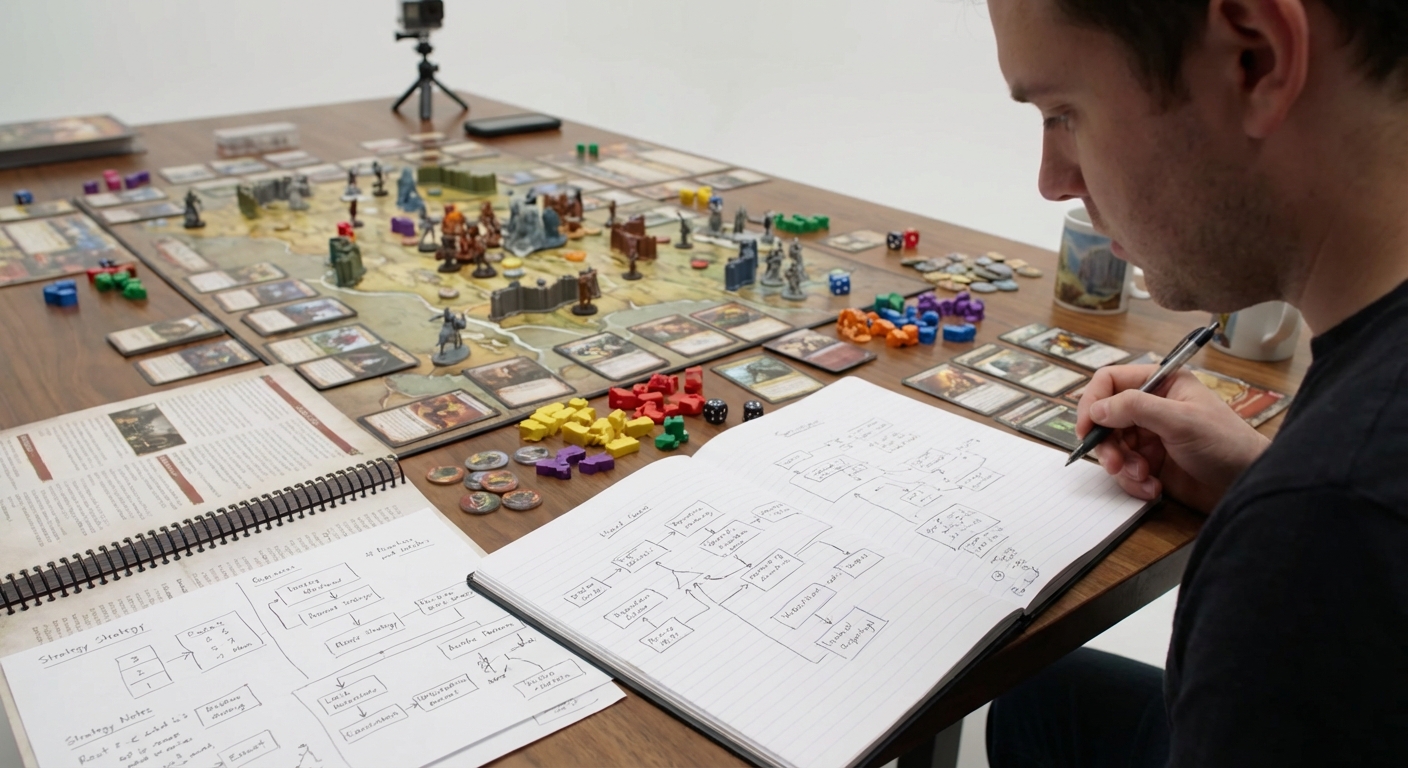
You know the player. New game, first play, still skims the rulebook—and somehow stomps everyone by 30 points. They’re not psychic; they’re internalizing strategy guide habits in real time.
Why Your Group’s Shark Always Wins
Whether you write guides or just consume them, there’s a specific skillset that transforms “I know the rules” into “I control this table.” Let’s break down 10 habits pulled straight from the best board game strategy guides—and the players who live them.
1. They Start with the Score Pad, Not the Setup
Strong players flip to the endgame scoring before placing a single piece.
Strategy guides treat the score pad (or scoring section) as the thesis statement of the game. Everything else is just how you get there.
Your habit: Before your first play, ask:
- What are the repeatable scoring sources?
- What are the one‑off big scoring swings?
- Is the game about steady income or explosive combos?
If a guide doesn’t walk you through scoring early, it’s incomplete.
2. They Hunt for Bottlenecks
Every game has a choke point. Great guides always identify it.
It might be:
- Limited worker spaces
- A tight market row
- A single track that controls turn order or bonus actions
Once you identify the bottleneck, you know where the real fight is.
Upgrade your play: When reading a guide, underline any mention of "contested spots," "priority actions," or "race conditions". That’s code for: fight here or fall behind.
3. They Classify Actions as Engine, Tempo, or Points
Strategy guides written by killers don’t just rank actions as good or bad. They classify them:
- Engine actions – Improve your future turns (income, cards, discounts)
- Tempo actions – Manipulate order, block spaces, or accelerate the clock
- Point actions – Direct scoring, usually late‑game priority
Table tyrants evaluate every option through this lens.
Your habit: During a game, ask: Is this strengthening my engine, seizing tempo, or scoring now? If it’s “none of the above,” it’s probably a trap.
4. They Love “First 3 Turns” Sections
The best guides don’t start at theory; they drop you into turn one.
Powerful opening sections look like this:
- “If you draft this faction, prioritize X and Y in your first two actions.”
- “Never spend your starting coin on Z; it delays your engine by a full round.”
These details create massive skill gaps fast.
Your habit: When you find a guide with strong openings:
- Print or screenshot the first‑3‑turns advice
- Play it precisely once
- Then adapt based on table dynamics
Openings are a launch pad, not a script.
5. They Respect Component Clarity as a Competitive Edge
Savvy players quietly weaponize component layout and ergonomics.
- Dual‑layer boards? Perfect for planning multi‑step engine turns without bumping cubes.
- Icon‑heavy player aids? Cheat sheets for spotting synergies.
- Bad iconography? They’ll over‑prepare and memorize what others misread.
Good guides call this out: “This resource icon is small but crucial; watch it like a hawk.”
Your habit: Before the game, do a 60‑second "component scan":
- Where is information hidden on the board?
- Which tracks or tokens are easy to forget?
Your future self will thank you.
6. They Read Player Count Notes like Matchup Guides
Strategy guides that gloss over player count differences are leaving wins on the table.
High‑level players know:
- At 2 players, denial and tempo skyrocket in value.
- At 4 players, prediction gets harder; flexible engines are safer.
- Some actions go from “meh” at 2 to “mandatory” at 5.
Your habit: When consuming a strategy guide, jump straight to the player‑count comments. Treat them like matchup notes in a competitive video game.
7. They Treat “Common Mistakes” as a Checklist
The best section in any guide? “What new players do wrong.”
These lists are pure gold:
- Over‑investing in low‑impact tracks
- Hoarding resources too long
- Ignoring endgame triggers
Your habit: Before your next play, turn that section into a live checklist:
- Am I overspending for tiny points?
- Am I building engine pieces with no time left to use them?
- Am I letting someone else control the endgame clock?
Play with this in mind and you’ll leapfrog months of casual play.
8. They Look for “Breakpoints” and Thresholds
Elite strategy guides talk about breakpoints:
- “Once you have 3 income, shift from economy to scoring.”
- “Hitting level 4 on this track is enough; going to 5 is usually overkill.”
Knowing where to stop investing is as important as knowing where to start.
Your habit: While reading a guide, highlight phrases that describe “enough” or “usually not worth it.” That’s your blueprint for efficiency.
9. They Embrace Opinionated Pros and Cons
The sharpest guides are not neutral. They tell you:
- "This strategy is overvalued by new players."
- "This expansion adds chrome, not depth."
- "This faction is training‑wheels strong at low skill, weaker at high skill."
This honesty speeds up your understanding of the real meta.
Your habit: Prefer guides that take a stand over ones that say "it depends" for 12 paragraphs. The meta always evolves; you want a clear baseline, not a shrug.
10. They Use Guides to Ask Better Questions, Not Memorize Lines
Pros don’t memorize entire guides. They harvest questions from them:
- “In this game, is economy or tempo more important early?”
- “What’s the realistic max score for this strategy line?”
- “What’s the main way to punish greedy engines?”
Then they test these questions on the table.
Your habit: The next time you read a guide, write down 3 questions you want to answer in your next play. You’ve just turned passive reading into active improvement.
The Meta Is Yours for the Taking
Strategy guides aren’t sacred texts; they’re distilled experience. Learn to read them like a shark and you’ll start playing like one.
Adopt these 10 habits and you’ll feel the shift: suddenly you’re seeing engines earlier, dodging traps, and making snaps that look like 4D chess to everyone else.
You don’t need more games on your shelf to level up. You need better habits—and a sharper way to use the guides you already have.