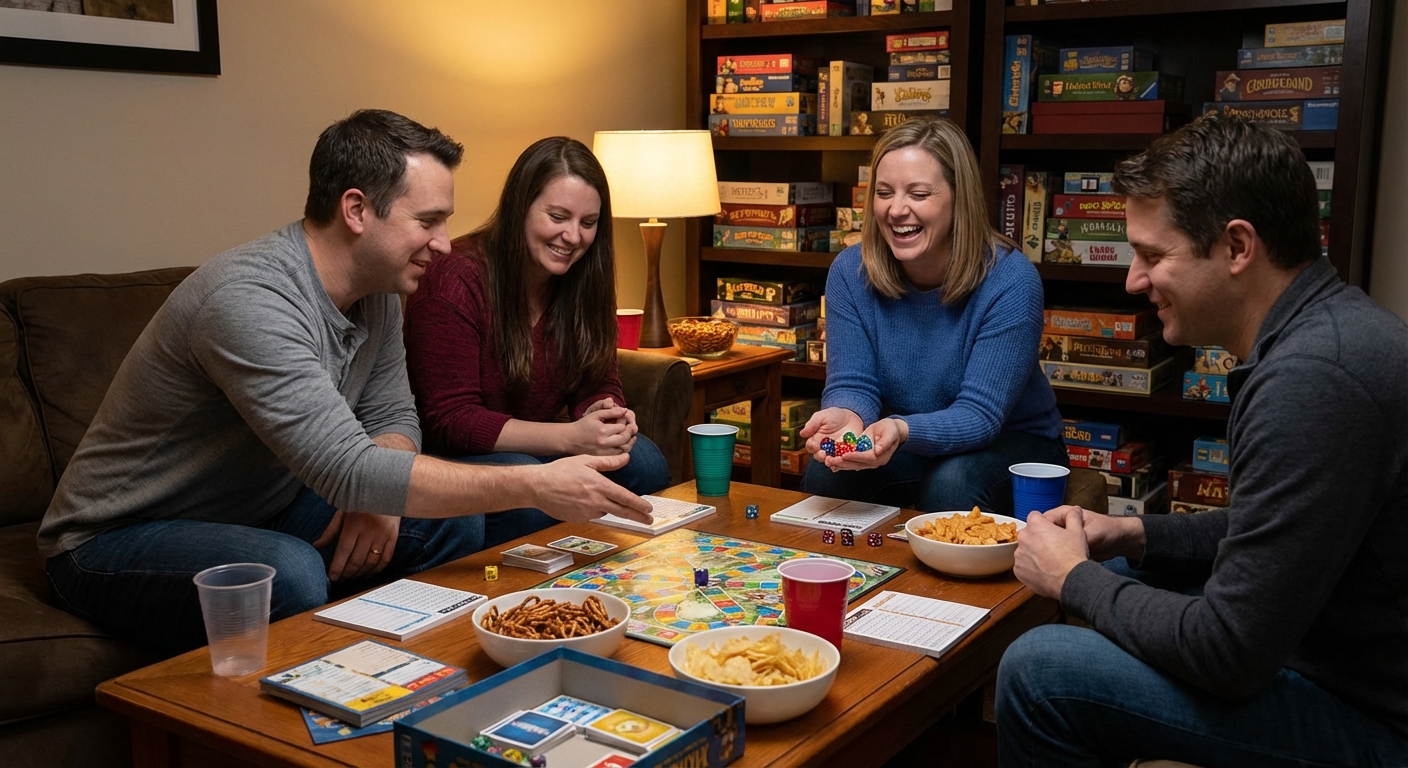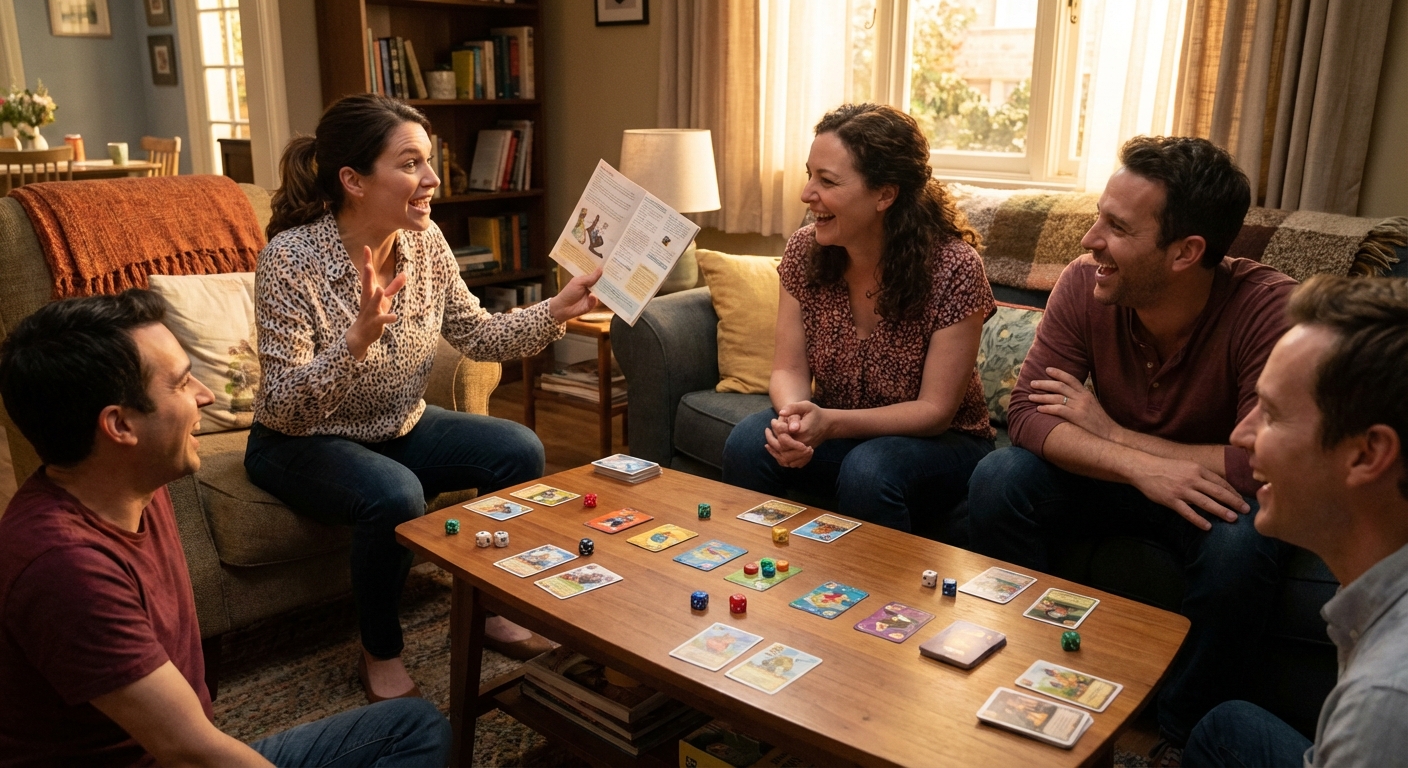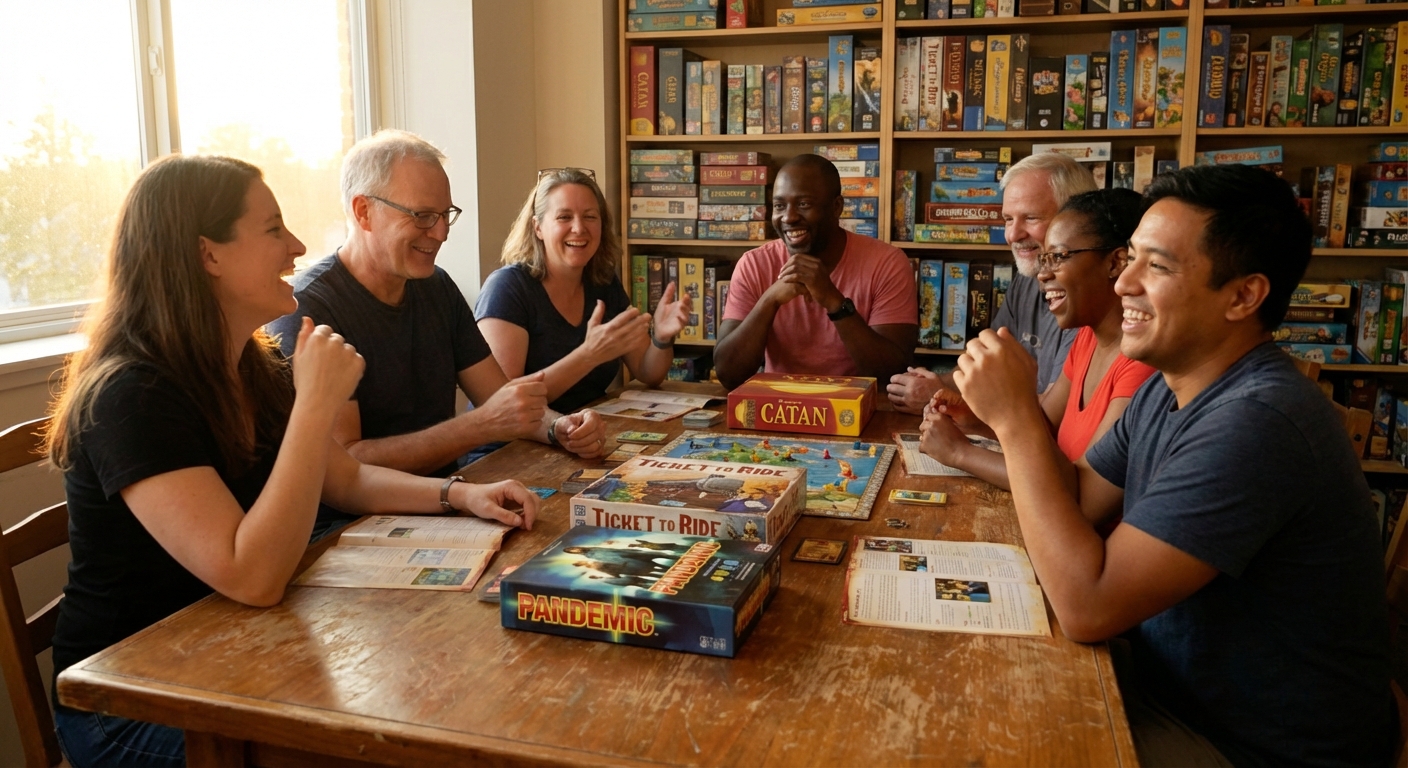
Party games have a reputation problem. To non-gamers, they’re disposable, loud, and shallow. To hobbyists, they’re often a compromise you grudgingly bring out for family gatherings.
Why Hobbyists Deserve Better Party Games
But the last decade has produced an entire tier of hobby-grade party games: rules-light, yes, but packed with clever design, emergent strategy, and real replay value.
Let’s walk through seven standouts that respect your brain and keep the table roaring.
1. Decrypto – The Thinky Team Word Game That Makes Codenames Feel Gentle
Player count: 3–8
Best at: 4–6
Core hook: Two teams give coded clues to communicate numbers 1–4… while the other team eavesdrops and tries to break your code.
Why It Works for Hobbyists
Decrypto layers deduction over wordplay. Unlike Codenames, you’re not just finding words; you’re building and evolving a code system. Each round adds historical clues, so the longer you play, the more paranoid and nuanced it becomes.
Strategic Tips
- Clue arc management: Early rounds: be obvious to your own team. Mid-game: start throwing in misleading side associations to scramble opponent inference. Late game: strongly lean on internal references only your team understands.
- Risk calibration: Don’t overcomplicate too soon. A broken code is worse than a stolen word. If the opponents haven’t sniffed your pattern, keep it boring.
Component Notes
Card quality is solid; the chunky "decoder" screens are excellent table presence and functional. The only weak spot is the tiny text on some words in low light.
Pros:
- High skill ceiling for a party game
- Constant engagement; no real downtime
- Excellent with gaming groups that love deduction
- Can be opaque or stressful for casual players
- Requires focus; not ideal for noisy bar environments
Cons:
2. Wavelength – Social Deduction Disguised as a Vibe Check
Player count: 2–12
Best at: 6+
Core hook: One player sees where a dial lies on a hidden spectrum and gives a clue; teammates debate and place the dial where they think it belongs.
Why It Works for Hobbyists
Under the friendly exterior, Wavelength is about modeling other humans. It’s part social deduction, part psych exam, part meta-gaming your friends.
Strategic Tips
- Exploit personal meta: Use clues based on shared experiences (your group’s memes, in-jokes, past games) to tighten the signal.
- Calibrate extremes: Don’t always anchor on the ends (e.g., “hot/cold”). Use deliberately middling examples to aim for the center segments.
Component Notes
The plastic dial contraption feels sturdy and visually striking. Cards are thick and linen-finished. The only downside: the box is larger than it needs to be.
Pros:
- Incredible table talk and argument generation
- Works with mixed gamer/non-gamer groups
- Surprisingly deep if you lean into meta
- Loses some spark with strangers who lack shared context
- Some prompts are duds; expect to curate or skip
Cons:
3. Just One – Cooperative Party Filler With Real Signal Theory
Player count: 3–7
Best at: 5–7
Core hook: Everyone writes a one-word clue to help one player guess a secret word. Identical clues cancel out.
Why It Works for Hobbyists
It’s a short, accessible system that secretly teaches information theory. The tension is between being obvious (useful but likely to cancel) and being creative (risky but unique).
Strategic Tips
- Orthogonal clueing: Think in dimensions: meaning, category, rhyme, inside jokes. Don’t always chase the most direct synonym.
- Risk management: When you sense the group will converge on a clue, intentionally pivot to a related but off-beat hint to avoid cancellation.
Component Notes
Easel stands and markers are functional, if unremarkable. Cards are fine but generic. This could have used more indulgent production; the design deserves it.
Pros:
- Teach-and-play in under 2 minutes
- Scales well up to 7 players
- Surprisingly tense and clever
- Word list can exhaust with heavy play; expansions or fan lists help
- Alpha gamers may over-explain their “meta” between rounds
Cons:
4. Monikers – The Definitive “Dumb Energy, Smart Design” Party Game
Player count: 4–20+
Best at: 8–12
Core hook: The same deck of cards is used across three rounds: describe the clue, use one word, then charades only.
Why It Works for Hobbyists
Monikers nails arc-based design. The first round seeds the table’s jokes and shared references; the second and third rounds become performance art based on those seeds.
Strategic Tips
- Draft discipline: When drafting cards, prioritize names and references your group will exploit later, not just recognize.
- Memory tracking: Pay serious attention in round one. The payoff in rounds two and three is dramatic if you remember exact titles and quirks.
Component Notes
Art is stylish and consistently funny. Card stock is excellent. The base game plus a curated expansion is usually enough for an entire year’s worth of parties.
Pros:
- Builds its own in-jokes every session
- Flexible length and player count
- Works brilliantly with alcohol and sober groups
- Heavily cultural/Western reference pool
- Requires moderate reading and pop culture literacy
Cons:
5. So Clover! – Quietly One of the Best Cooperative Party Puzzlers
Player count: 3–6
Best at: 4–5
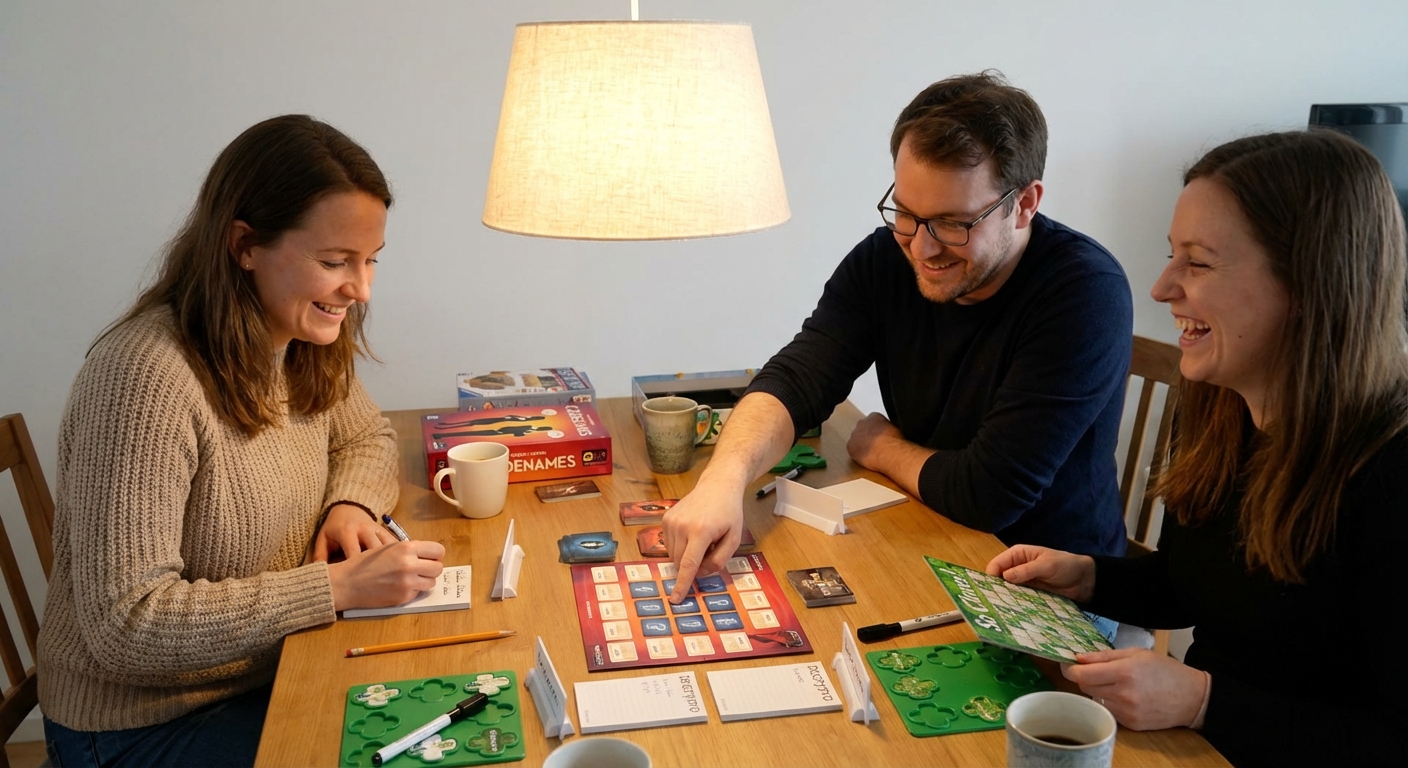
Core hook: Each player has a clover board with 4 word pairs on the edges. You write a single clue per edge, then others reconstruct the correct word layout.
Why It Works for Hobbyists
So Clover! has a satisfying spatial and semantic puzzle. You’re not just linking words; you’re balancing four pairs at once with each clue.
Strategic Tips
- Two-step thinking: First find a concept that links each pair. Then check that concept doesn’t accidentally strongly suggest any other words.
- Group calibration: After a few plays, start tracking your scores and setting group “records” to chase. The design shines with a bit of competitive framing.
Component Notes
The plastic clover boards are chunky, tactile, and clever. Marker ink wipes clean. Word tiles are decent but can be fiddly if sleeves or drinks clutter the table.
Pros:
- Genuinely cooperative with no quarterback problem
- Excellent blend of wordplay and spatial logic
- Quiet but deeply satisfying
- Table needs to see the clover clearly; tight spaces are awkward
- Not ideal for very large, chaotic parties
Cons:
6. Insider – Hidden Traitor Meets 20 Questions
Player count: 4–8
Best at: 5–6
Core hook: Everyone plays 20 Questions. One player secretly knows the answer and must subtly steer questions… without getting caught.
Why It Works for Hobbyists
Insider is social deduction boiled down to 15 minutes. It plays like One Night Ultimate Werewolf, but without role salad or rules overhead.
Strategic Tips
- As Insider: Ask one or two terrible questions early to seed plausible deniability; then guide more precisely mid-game.
- As commoner: Track who asks the strongest narrowing questions and when their confidence spikes.
Component Notes
The box is overkill for what’s basically a handful of cards, but at least they’re durable. Could easily live in a wallet or pocket.
Pros:
- Lightning fast setup and play
- Great palate cleanser between heavier games
- Tiny footprint; perfect convention line game
- Fragile with groups that dislike accusation
- Needs honesty and basic social calibration to shine
Cons:
7. The Crew (Any Mission Pack) – The Trick-Taking Party Game in Disguise
Player count: 2–5
Best at: 4
Core hook: Cooperative trick-taking with communication restrictions and evolving missions.
Yes, it’s technically not a “party game,” but at many hobby tables, it becomes one.
Why It Works for Hobbyists
If your group has card game literacy, The Crew becomes a tense, hilarious communication puzzle. Watching your friends try to “say” things with off-suit junk cards is honestly party-level entertainment.
Strategic Tips
- Signal discipline: Don’t waste your communication token on mediocre info. Save it for either your only card of a color or a mission-critical number.
- Sacrificial tricks: Sometimes your job is to burn high cards early to open control for someone else; embrace the support role.
Component Notes
Cards are sturdy with clear iconography. The logbook and mission structure add long-term value. A sleeve-friendly design if you expect heavy use.
Pros:
- Deep, repeatable challenge
- Smooth ramp from easy to brain-melting
- Scratches "serious game" itch in party-length sessions
- Requires at least one trick-taking literate player to teach
- Not ideal for very casual or very drunk groups
Cons:
Final Thoughts: Curating a Smart Party Arsenal
If you’re a dedicated hobbyist, you don’t need to settle for throwaway party games. Build a small, sharp arsenal:
- For mixed groups: Wavelength, Just One, So Clover!
- For hardcore gamers: Decrypto, The Crew, Insider
- For big chaotic nights: Monikers
Bring these to your next meetup and watch the skeptics realize that “party game” no longer means “mindless.” It can mean fast, sharp, and brutally clever—exactly what a dedicated gamer deserves.