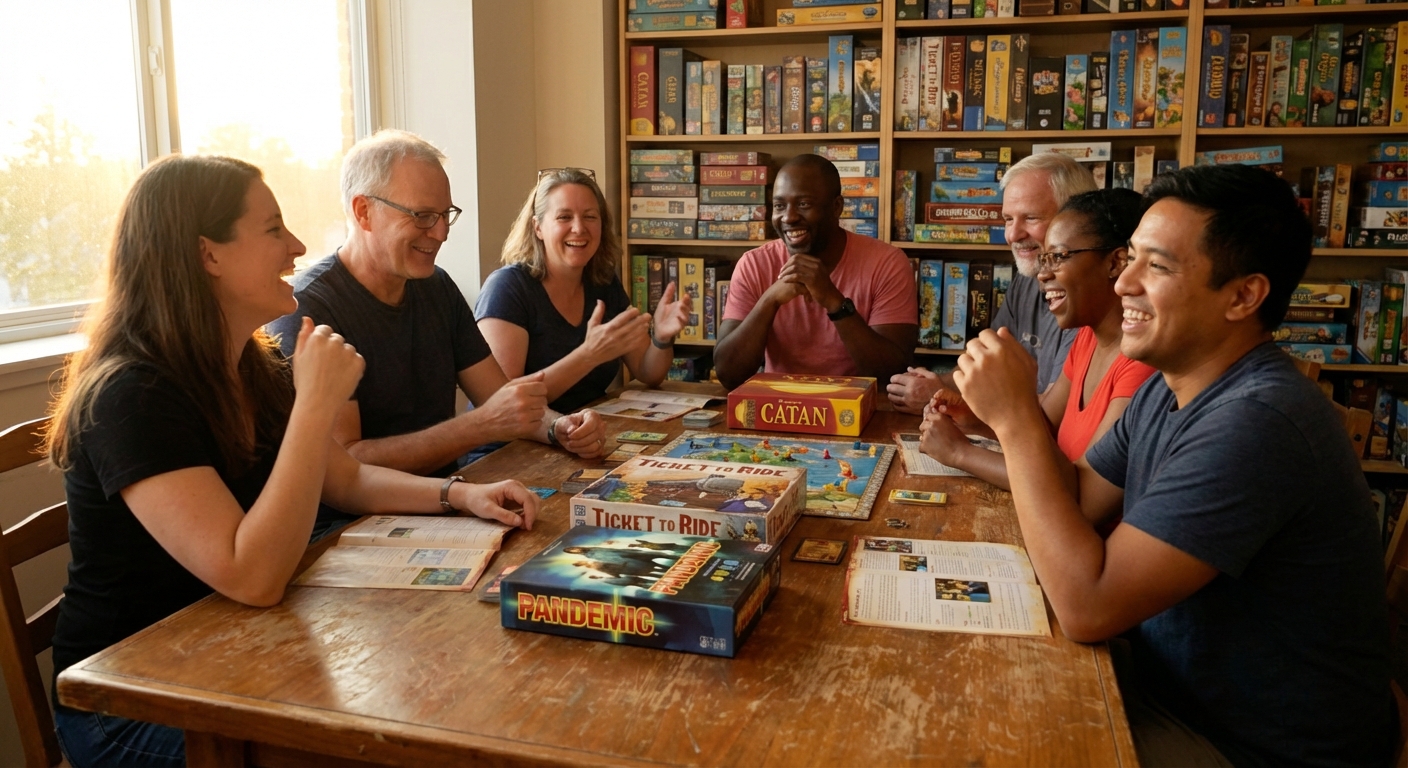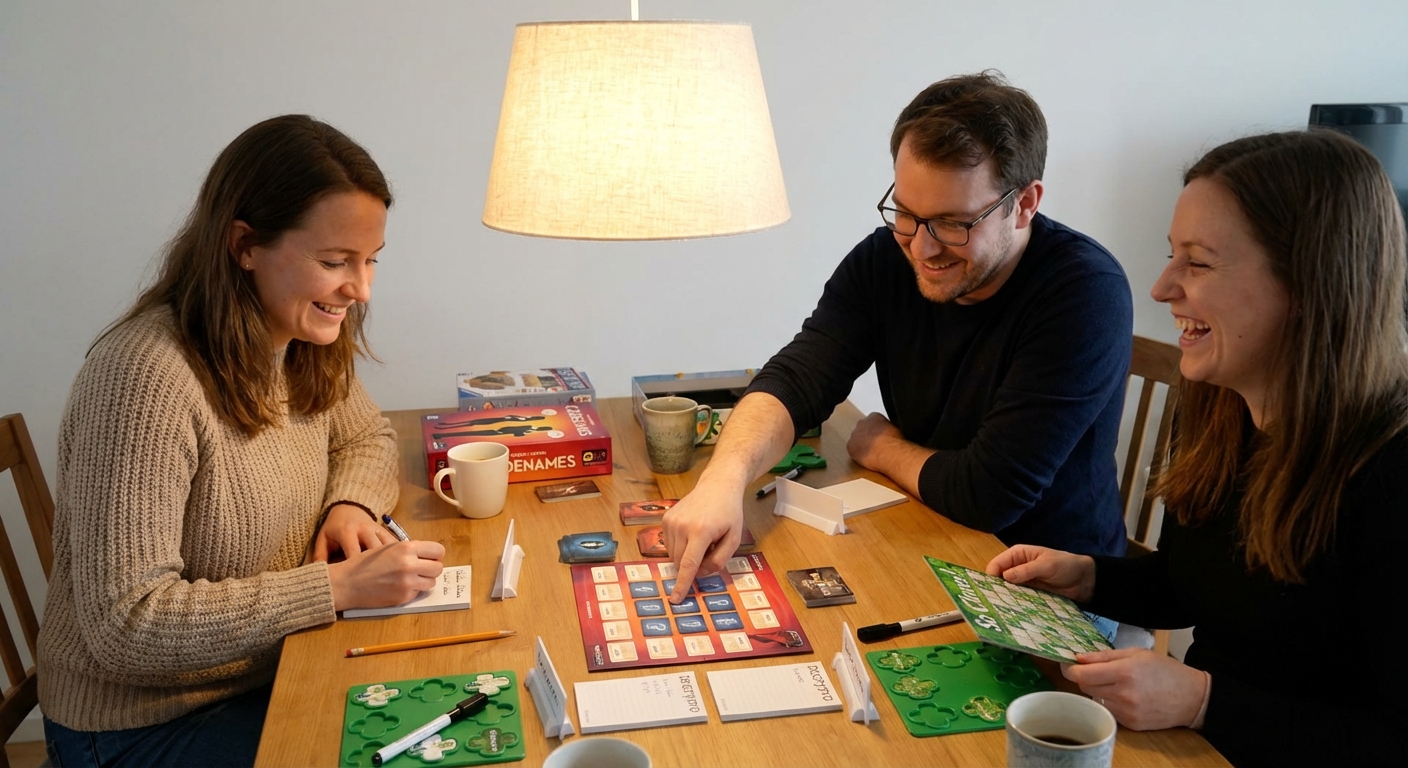
A lot of dedicated gamers treat party games like clever coin flips: you play them for laughs, not for mastery. That’s a waste. Modern party games hide real skill expression under all the shouting and table talk.
Party Games Aren’t Random—You’re Just Playing Them Lazily
If you’ve ever thought, “We always lose at Decrypto,” or “Why does that one friend always crush Just One?”—this article is for you.
Let’s dissect how to play modern party games well. Not just “try your best,” but concrete strategic frameworks for popular titles, while still keeping them fun.
We’ll focus on:
- Decrypto
- Just One
- Wavelength
- So Clover!
- Monikers
These don’t need perfect play, but understanding their skill edges makes every session sharper.
Decrypto: Stop Overthinking Your Clues, Start Thinking Their History
Decrypto punishes both cowardice and ego. Good teams navigate a narrow path:
1. Think in Clue Families, Not Individual Clues
Each of your four words should have at least three conceptual “families” you can draw from (e.g., for "PIRATE": crime, sea, movies).
- Early game: lean on broad, generic associations ("ship," "treasure").
- Mid game: mix families ("Disney" for Pirates of the Caribbean).
- Late game: lean on table meta ("Jordan’s hat," "that Halloween party"), which opponents can’t easily decode.
2. Track Opponent Assumptions Actively
You’re not just decoding words; you’re decoding how the opposing team thinks.
- Note when their clues suddenly become “safer” or extremely awkward—that’s a sign you’re close to cracking a word, and they’re panicking.
- Guess a full mapping only when you can tie at least two words to consistent themes; don’t waste a guess on wild speculation.
3. Accept Imperfect Communication
The most common losing pattern: clue-givers trying to give the perfect clue, overcomplicating, and losing their own team.
- Rule of thumb: if your clue makes sense in two steps of association, it’s probably okay. If it needs three plus backflips, it’s too much.
Just One: Play the Table, Not the Word
In Just One, everyone writes one clue. Duplicates vanish. High-level play is about anticipating overlaps and intentionally avoiding them.
1. Identify the “Obvious” Clues, Then Dodge
Before writing, mentally list the top 2–3 obvious clues. Then do not write them.
Instead:
- Hit a related category (for "APPLE": "orchard" instead of "fruit").
- Use clear but second-tier references ("Mac" is riskier than "fruit," but powerful if it sticks).
2. Calibrate Group Conservatism
Watch your group for 3–4 rounds:
- If they’re conservative, you can safely play more aggressive synonyms.
- If everyone’s getting cute, you might need to be more straightforward to keep at least one anchor clue.
3. Use Distribution Thinking
You want the aggregate set of clues to triangulate the word.
- Don’t duplicate a type of clue (e.g., all synonyms, all brands). If someone else likely gives “fruit” for APPLE, lean into “iPhone” or “Newton.”
Wavelength: Model the Clue-Giver, Not the Spectrum
Most players treat Wavelength as if the dial is the puzzle. It isn’t. The person giving the clue is.
1. Build a Profile for Each Clue-Giver
After 1–2 rounds with each player, you should know:
- Do they exaggerate extremes?
- Do they like niche, personal references or broad cultural ones?
- Do they round "medium" up or down?
Store that. Use it.
2. Argue Deliberately, Not Loudly
Good table talk sounds like this:
- "If this were ME, I’d pick X. But this is Sam, who hates spicy food, so his 'spicy' is weaker than ours."
- "They referenced our last game night, so they’re using very personal calibration, not generic."
Bad table talk: “I dunno, 6? 7? 6.5?”
3. As Clue-Giver, Embrace Commitments
Pick references that are strongly polarized for your group. Avoid:
- obscure indie bands, unless everyone is a music nerd;
- generically “middle” references that cluster around 4–6 on the dial.
Make your team’s life easy by leaving no doubt which side of the spectrum you’re pointing to.
So Clover!: Design Clues for Future Misreaders
In So Clover!, your job isn’t just to connect pairs—it’s to prevent plausible wrong configurations.
1. Identify "Trap" Pairings First
Before writing anything, scan the 4x4 of visible words and ask:
- Which accidental pairings would be dangerously plausible to my teammates?
- Which words might be mistaken as intended neighbors?
Then craft clues that specifically disambiguate those.
2. Prefer Conceptual Over Literal Links
Literal clues are often too narrow and brittle. For example:
- Words: "FIRE" and "CHEF".
- Literal clue: "grill" (works, but could match other food-adjacent tiles).
- Conceptual clue: "Michelin" (narrower: restaurants, kitchens, intensity).
3. Watch the Group’s Solve Process
After your board is solved (or not), debrief:
- Ask what other tiles they considered.
- Use that data next time to calibrate how "obvious" certain associations are for your particular group.
This is how your team’s collective Clover skill improves over multiple sessions.
Monikers: Draft for Comedy and Future Efficiency
Monikers, at high level, is not random yelling. It’s about engineering future rounds.
1. Draft Names for Distinctiveness
In the draft, you want cards that:
- Can be described uniquely in round 1.
- Have instantly recallable physical or verbal handles for charades in round 3.
Avoid:
- Names that sound similar when shouted.
- Generic descriptors that will be impossible to pantomime clearly later.
2. Build Running Gags Intentionally
When you see a card with meme potential, lean into it:
- Give absurd descriptions in round 1.
- Use exaggerated voices or motions in round 2.
- By round 3, the table will guess with just a stance or syllable.
This is not frivolous—well-built gags compress information, making later rounds smoother and funnier.
3. Time Discipline Wins Games
The limiting factor is the timer, not knowledge.
- Don’t waste precious seconds flipping cards back and forth; if a card stumps you for 2–3 seconds, pass immediately and come back if time remains.
- As guessers, shout early and often; let the describer sort hits from misses.
Component and Setup Hacks That Actually Matter
A few practical tweaks that give small but real edges:
- Better markers (So Clover!, Just One): Fine-tip wet-erase markers significantly improve legibility and reduce rewrite time.
- Dedicated score track (Decrypto, Just One): Use a separate track or app so you aren’t parsing scribbles and wasting mental bandwidth.
- Avoid glare (Codenames/Decrypto/So Clover!): Overhead lighting that reflects off laminated components will cost you clarity—and yes, that matters when clues are subtle.
Keeping It Fun While Playing to Win
Playing party games "seriously" doesn’t mean killing the vibe. It means:
- Owning your mistakes loudly instead of sulking.
- Treating each loss as data: Why did that clue fail? How can we calibrate differently?
- Mixing skill expression with table generosity—occasionally dial back your galaxy-brain tendencies if one player is clearly lost.
The best party groups develop shared ambition: we want to get better together, not just win individually.
Final Thought: Upgrade Your Party Game Brain
Next time someone suggests “just a quick party game,” don’t mentally clock out. Treat it like you would a sharp filler or a good abstract: simple rules, complex humans.
The skill is there. The strategy is there. And once you start applying it, you’ll never look at a party game as “break time” again—it’ll just be another arena to outthink your friends while you laugh in their faces.