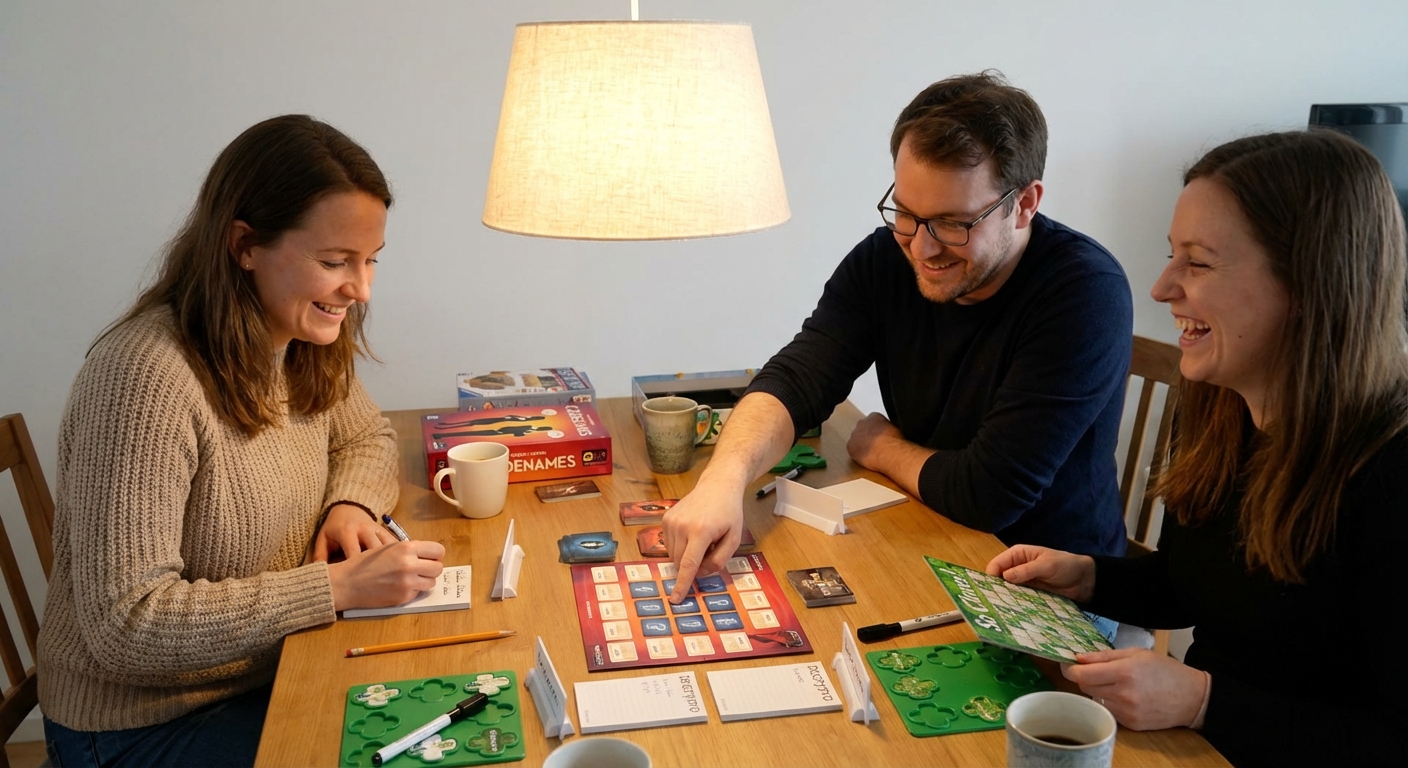
At this point, if you own board games, you probably own Codenames. Maybe you’ve heard the whispers about Decrypto. And recently, you’ve seen people quietly evangelizing So Clover! at conventions.
The Real Fight Isn’t Euro vs Ameritrash—it’s Word Game vs Word Game
They all target a similar niche: low-rules, high-table-talk word games. But they’re not interchangeable, and if you’re a dedicated hobbyist, your shelf probably doesn’t need all three.
Let’s break them down with a sharp, hobbyist-focused lens: mechanics, strategic depth, component quality, ideal player profiles, and where each one actually belongs in your rotation.
The Core Pitches in One Brutal Sentence
- Codenames: A flexible, accessible team word-association game that’s brilliant at first and slightly mushy on the hundredth play.
- Decrypto: A paranoid, evolving code-creation game where cleverness is a weapon that can absolutely backfire.
- So Clover!: A cooperative word+spatial puzzle that quietly offers some of the best pure design in the genre.
Mechanics Breakdown: How They Actually Play
Codenames – The Classic Grid
Structure: Two teams. 25 words in a 5x5 grid. Each team has a spymaster who gives one-word clues plus a number, trying to get their team to pick their correct words without hitting the assassin.
- Core tension: How greedy can the spymaster be with multi-word clues?
- Downtime: Non-spymasters mostly wait, then argue; actual decision space is limited but fun.
Skill expression:
- Strong vocabulary and pattern recognition help.
- There’s a soft cap on depth; after a while, groups lock into comfortable clue patterns.
Decrypto – The Code War
Structure: Two teams. Each team has four secret words, numbered 1–4. Round by round, each team’s clue-giver sees a sequence (e.g., 3-1-4) and must give three clues, one per word, so their team can guess the correct sequence. The opposing team listens and uses history to deduce which word is 1, 2, 3, 4.
- Core tension: Be clear enough for your team, but not so clear that the enemy cracks your mapping.
- Downtime: Minimal; you’re always listening, tracking, inferring.
Skill expression:
- Deep meta-building over multiple rounds.
- Real risk/reward management and information-control decisions.
So Clover! – The Semantic Polyomino
Structure: Each player gets a plastic clover with four double-sided word tiles inserted, creating 4 word pairs (one per edge). You secretly write a one-word clue per edge linking each pair. Then tiles are removed, shuffled, and others must reconstruct the correct layout.
- Core tension: Each clue must serve two words simultaneously without accidentally implying wrong ones.
- Downtime: Low; when you’re not clue-writing, you’re collectively solving.
Skill expression:
- Requires lateral thinking, but also error prediction—anticipating how your group will misinterpret.
Strategic Depth and Skill Ceiling
Codenames: High Floor, Moderate Ceiling
- Great for: Mixed groups, casual nights, low-stress competition.
- Skill curve: Early improvement is fast: new players quickly learn to think in categories and link multiple words at once.
- Plateau: After 20–30 plays with the same group, the game tends to devolve into familiar clue-workflows and safe patterns. You can push deeper, but most groups don’t.
For hobbyists, Codenames is now the “gateway euro” of word games: crucial historically, but overshadowed in depth.
Decrypto: The Deep Cut
- Great for: Players who enjoy deduction, information theory, and long-form meta.
- Skill curve: Steeper. New players often overcomplicate or under-signal clues, leading to code breaks or miscommunications.
- Ceiling: Very high. Experienced groups develop layered inside references, decoys, and deliberate misdirection.
Decrypto rewards investment. The more you play with the same team, the richer your code language becomes—until the other team weaponizes that same history against you.
So Clover!: Quietly Sharp
- Great for: Groups that like co-op thinking, gentle but clever puzzles, and minimal confrontation.
- Skill curve: Intuitive; most players feel competent quickly.
- Ceiling: Subtle. There’s less cutthroat interaction, but there is a lot of space for sophisticated clue crafting.
Unlike Decrypto, So Clover! isn’t about outwitting an enemy—it’s about collectively beating your past scores. For many hobby tables, that’s incredibly satisfying.
Component Quality and Table Presence
Codenames
- Components: Simple cards and a key card grid. Functional, not flashy.
- Durability: Cards hold up fine; sleeving only necessary for heavy pub/club use.
- Table presence: Recognizable, approachable, but visually bland by 2024 standards.
Decrypto
- Components: Solid word cards, team screens with sliding slots for word cards, and chunky clue sheets.
- Durability: Good. Screens are sturdy and iconic.
- Table presence: Those stand-up decoder screens look legit; the game looks more complex than it is, which can be a plus with hobby groups.
So Clover!
- Components: Excellent plastic clover boards, square word tiles, fine-tip markers.
- Durability: Outstanding. The boards feel like they’ll survive a nuclear winter.
- Table presence: Bright, tactile, inviting. New players gravitate toward the physical toy-like quality.
Verdict: So Clover! wins on pure ergonomic pleasure; Decrypto wins on thematic cool factor; Codenames is… fine.
Pros and Cons for Dedicated Gamers
Codenames – Pros
- Extremely easy to teach.
- Scales well to large groups.
- Tons of variants and packs (Pictures, Duet, thematic IP versions).
Codenames – Cons
- Strategic depth caps out quickly for committed groups.
- Non-spymasters can feel like passengers.
- Repetition: samey experience after dozens of plays without house variants.
Decrypto – Pros
- Genuinely tense, brainy, and rewarding.
- Everyone is engaged every round.
- High replay value—your meta evolves, not just the words.
Decrypto – Cons
- Intimidating to teach to non-gamers.
- Early mistakes (over-subtle clues) can snowball hard.
- Requires quieter environment; bar noise kills nuance.
So Clover! – Pros
- Co-op, low-conflict but not dull.
- Satisfying puzzle with almost zero rules load.
- Great component feel and visual clarity.
So Clover! – Cons
- Limited player count (3–6 sweet spot).
- Can feel “samey” if overplayed in a short window.
- Some word tiles are awkward or too narrow in association space.
Which One Should You Buy (or Keep)?
If You Frequently Host Mixed Gamer/Non-Gamer Groups
- Primary pick: So Clover! – Lowest friction, high satisfaction.
- Secondary: Keep Codenames if your crowd already loves it; otherwise, skip straight to Clover.
If Your Group is Strategically Aggressive and Loves Deduction
- Primary pick: Decrypto, no contest.
- Secondary: So Clover! as a warmup; Codenames only if you want a "soft" alternative.
If You Often Play at 8+ Players
- Primary pick: Codenames or Codenames: Pictures – still one of the cleanest large-group options.
- Secondary: Decrypto can stretch to 8, but So Clover! really can’t.
If Shelf Space and Budget Are Tight
For a dedicated gamer with a sharp group, I’d rank them:
- Decrypto – For depth and long-term interest.
- So Clover! – For flexibility and co-op charm.
- Codenames – Only if you host lots of non-gamers or need a 10+ player option.
How They Fit Together in a Single Night
If you do own all three, they can coexist:
- Start with So Clover! as a cooperative calibration puzzle.
- Move to Decrypto as the high-intensity main event.
- End with Codenames: Pictures when people are tired but still want to chat.
This configuration uses each game where it’s strongest: Clover for onboarding, Decrypto for peak tension, Codenames for relaxed banter.
Final Verdict: The Hobbyist’s Core Word-Game Choice
If you’re curating a lean, high-signal collection for a dedicated board game group:
- Decrypto is your brainy competitive flagship.
- So Clover! is your co-op workhorse that always lands.
- Codenames has become the gateway classic—still worthy, but no longer untouchable.
You don’t need all three, but if you do keep them, treat them as different tools: the scalpel (Decrypto), the warm hug (So Clover!), and the familiar handshake (Codenames).