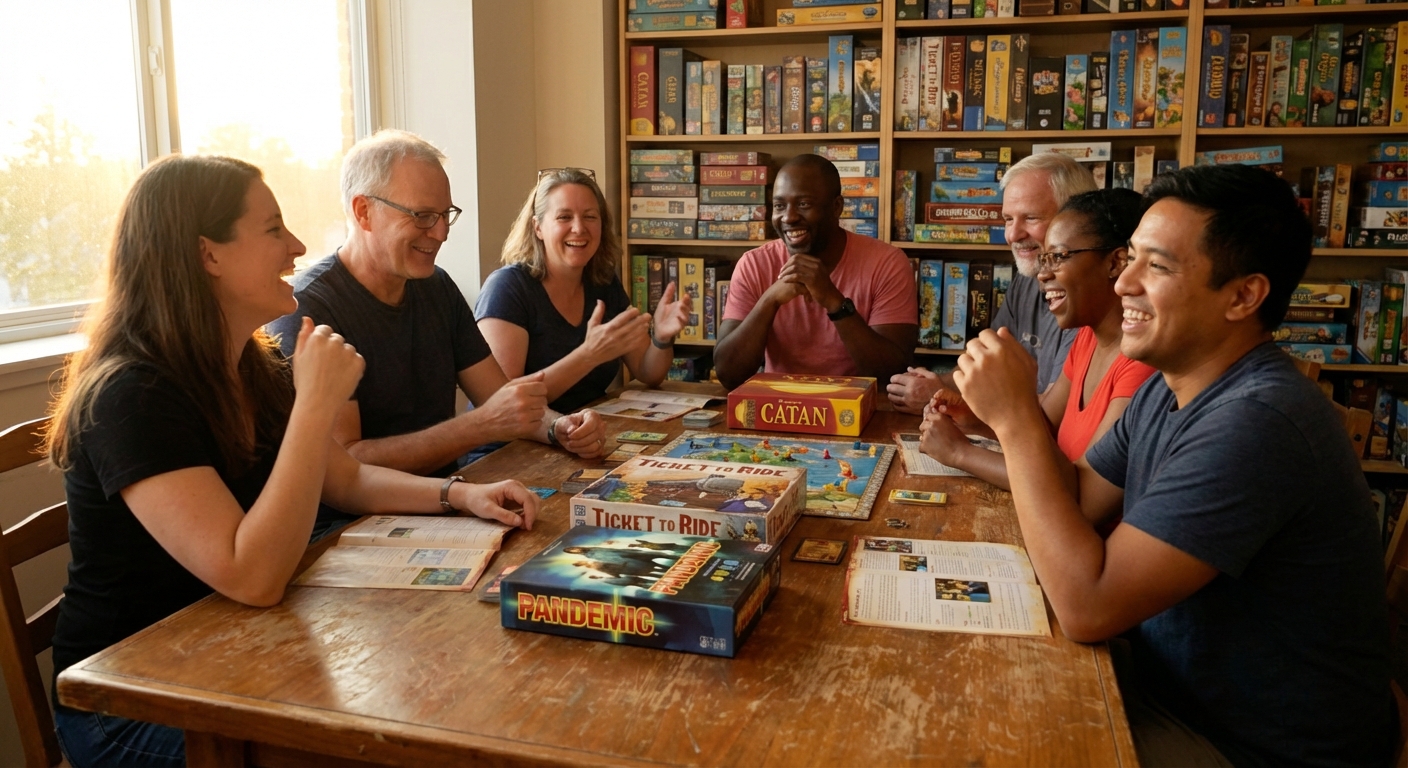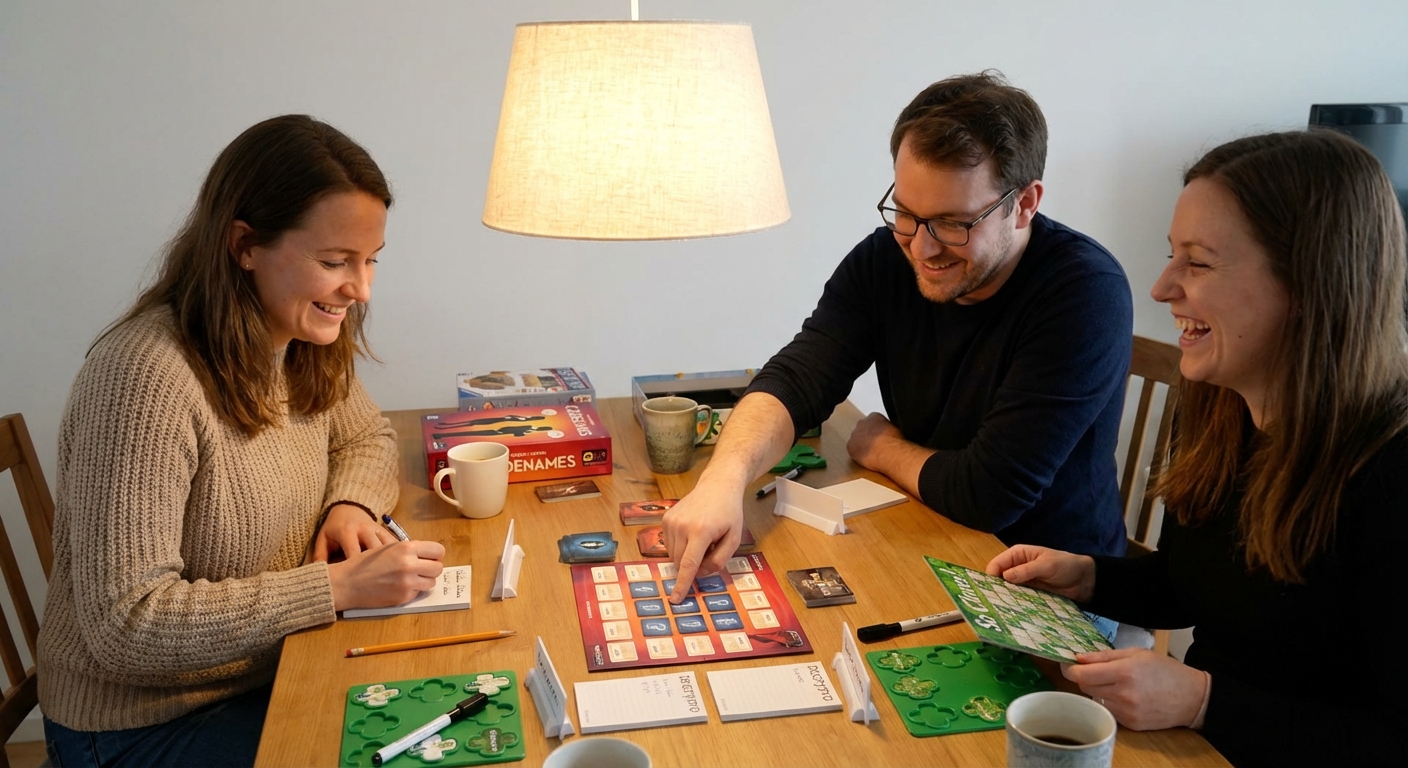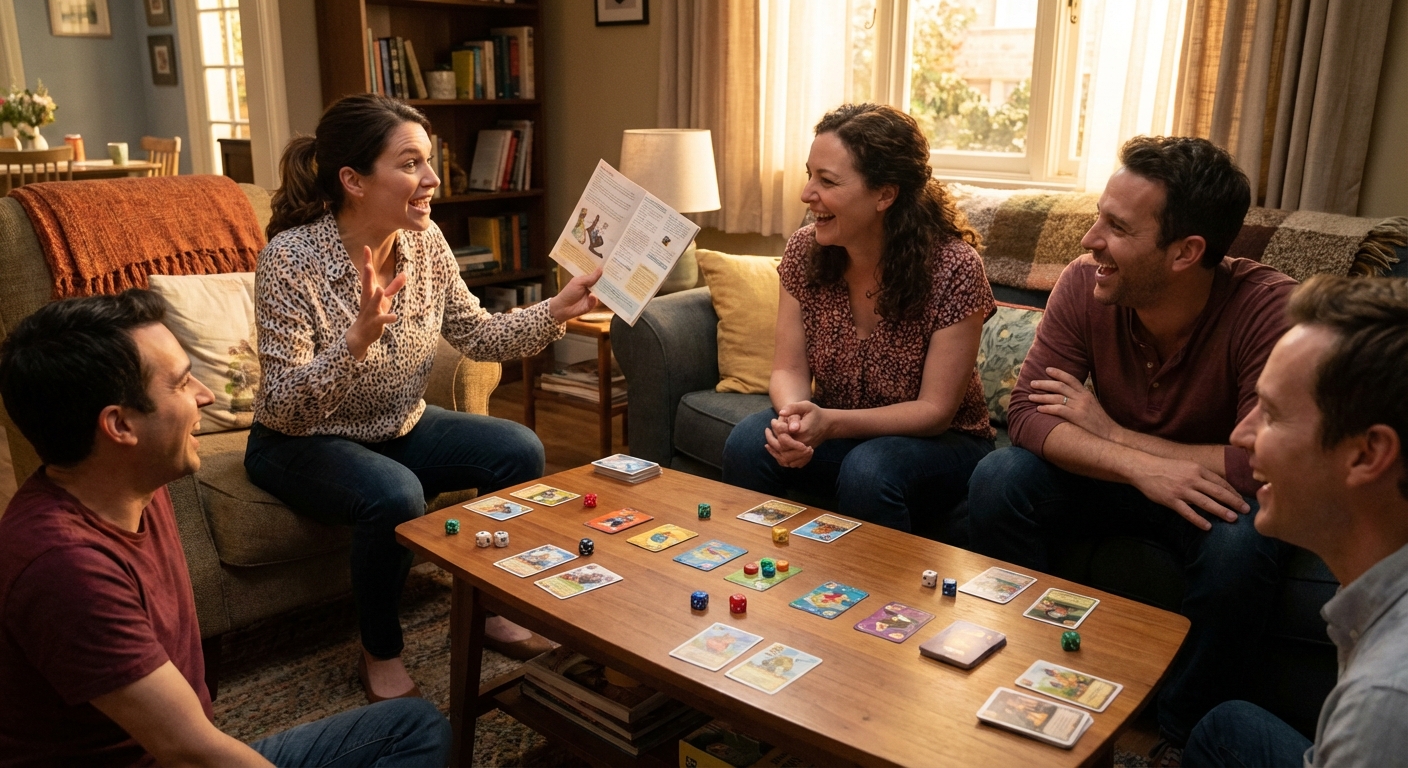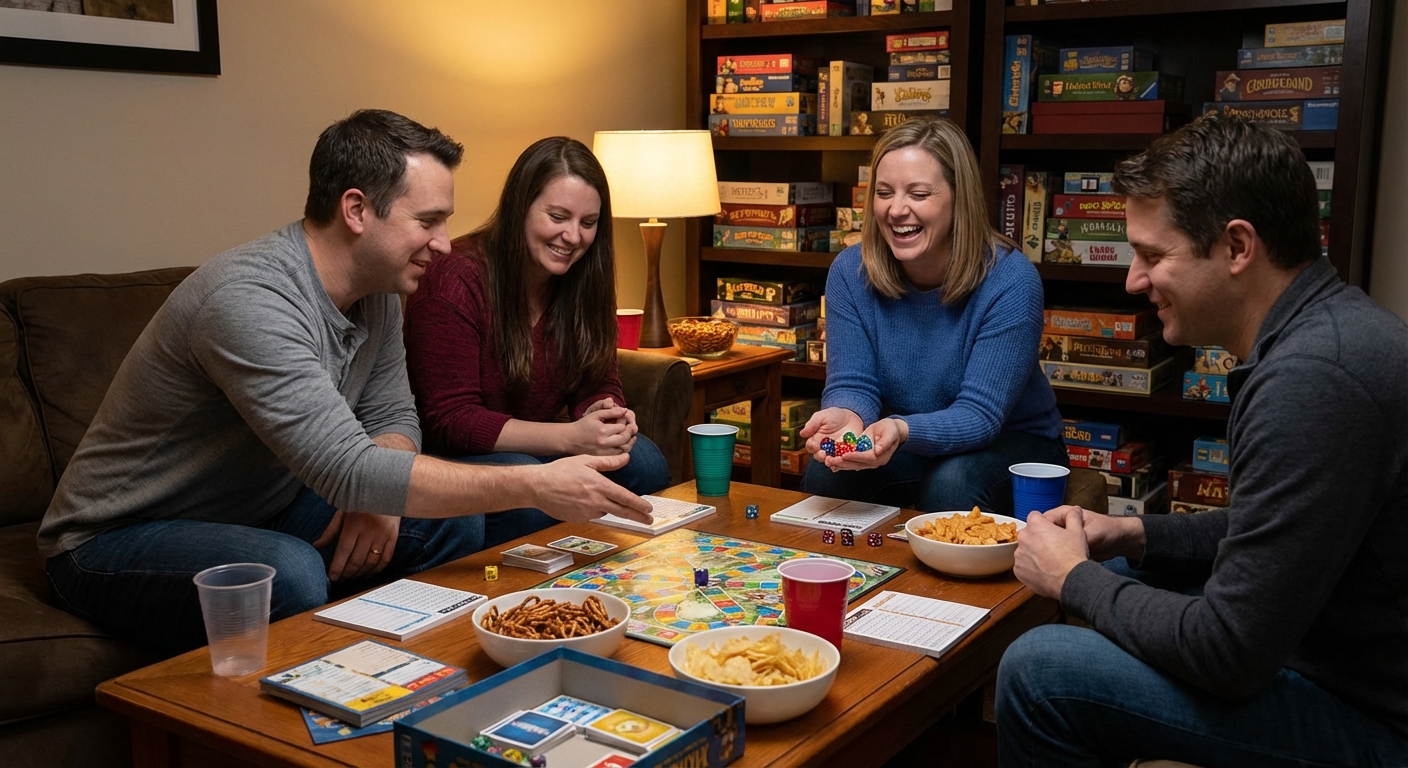
If you’re a dedicated hobbyist, you’ve probably said this: “We’ll warm up with a party game and then play a real game.”
Stop Apologizing for Party Games
That mindset wastes one of your most versatile tools. A well-curated party-game night can be as strategic, intense, and memorable as any six-hour campaign of Twilight Imperium—just with more laughter and less existential fatigue.
This guide walks you through designing a killer party-game night specifically for experienced gamers: pacing, table layout, rules teaching, and a modular lineup of titles that hit hard without dumbing things down.
Step 1: Define the Mood and Skill Curve
Before you pick a single box, decide on two things:
Energy level: Do you want boisterous chaos or tight, thinky tension?
Cognitive load: Is this a “we just worked all week” night, or a “we’re sharp and ready to sweat” night?
For dedicated gamers, I like a three-act structure:
- Act I – Social Warmup: Medium energy, lowish rules complexity, lots of interaction.
- Act II – Peak Intensity: Highest think level and energy; the showpiece of the night.
- Act III – Controlled Cooldown: Still smart, but shorter and lighter as brains and voices get tired.
Step 2: Curate a Modular Lineup
Here’s a reusable blueprint designed for hobbyists, with game recommendations and why they work.
Act I – Warmup (60–90 minutes total)
Goal: Get everyone talking, calibrating to each other’s humor and thinking styles.
Strong picks:
- So Clover! – Cooperative, low-pressure, deeply clever word+spatial puzzle.
- Just One – Ultra-fast co-op signaling game that establishes how “obvious” your group tends to be.
- Wavelength – Excellent for reading the room and building instant meta.
Why these work:
- They teach your group’s vocabulary and tendencies before more cutthroat games.
- Rules take 3–5 minutes max.
- No one can “fail horribly” on their first turn, which matters for table confidence.
Expert tip: Start with the most cooperative game first. It creates goodwill and shared jokes that you’ll weaponize later in competitive titles.
Act II – Peak Game (60–120 minutes)
Goal: Deliver a game (or two) that hits your group’s strategic sweet spot.
Hobbyist-friendly headliners:
- Decrypto (4–8 players)
- Codenames: Duet in team mode (if you insist on Codenames, at least play the sharper one)
- The Crew (2–5 players, but works great as a rotating “feature table” in a bigger group)
- Blood on the Clocktower lite script or Insider for heavy social deduction fans
Decrypto as a centerpiece:
Decrypto is nearly perfect here:
- It rewards the shared vocabulary built in Act I.
- It provides real trajectory: round 1 feels simple, round 4 is deeply paranoid.
- Everyone is engaged at all times—no “spectator turns.”
Managing complexity:
- Use ONE big showpiece. Don’t try to cram two heavy party games back-to-back; it burns attention.
- After 4–6 rounds of Decrypto or 6–8 missions of The Crew, stop. Leave them wanting more.
Act III – Cooldown Without Switching Off (30–60 minutes)
Goal: Keep people playing while their brains wind down.
Perfect closers:
- Monikers – If you have 8+ people and energy to spare.
- Insider – If you want short, sharp, and mean in 15-minute bursts.
- Dixit / Mysterium Park – For a more visual, interpretive vibe.
You’re looking for games that:
- Mostly run on social momentum you’ve already built.
- Allow players to mentally coast but still contribute.
- Can be dropped at any time without feeling “unfinished.”
Pro move: End the night one game earlier than you think you should. Ending on a high reinforces the memory of the whole event.
Step 3: Optimize the Physical Setup Like It’s a Tournament
Dedicated gamers obsess over component quality, but rarely over table ergonomics. For party games, this matters even more.
Visibility and Reach
- Use a long side of the table for the main display (word grids, dials, clovers) so the maximum number of players sees clearly.
- Elevate central components slightly using game boxes or a board underneath—this makes a big difference for Codenames, So Clover!, and Decrypto.
Noise and Seating
- For team games (Decrypto, Wavelength, Codenames), seat teams intermingled rather than on opposite sides. Cross-talk is louder, but engagement is higher.
- Kill "side tables" of conversation by deliberately rotating seats between Acts I and II.
Component Tweaks
- Invest in fine-tip wet-erase markers for So Clover! and Just One. The stock markers are acceptable but usually too thick and dry quickly.
- Sleeve high-use word cards (Decrypto, Just One) if your group snacks aggressively. Party games see more table abuse than your fancy euro.
Step 4: Teach Like a Pro (In Under 3 Minutes)
Party games live or die on rules onboarding. Gamers tolerate clunky teach-ins for 90-minute euros; they will not for a 15-minute party filler.
Use this structure:
- One-sentence pitch – “This is a co-op word puzzle where we’re trying to reconstruct hidden connections.”
- Core loop – “On your turn, you’ll do X. Everyone else does Y. We repeat until Z.”
- Win/Loss condition – “We’re trying to score 10. If we make 3 mistakes, we lose.”
- One example – Walk through one simple turn, out loud.
- Edge cases later – Don’t explain rare corner rules until they happen.
If your teach takes longer than a full round of the game, you’ve overexplained.
Step 5: Use Meta and House Rules Intentionally
Hard truth: most party games become great or garbage based on group meta and a few smart house rules.
Tight, Useful House Rules
- Just One – Ban purely numeric/letter clues unless the group explicitly agrees. It keeps the game linguistic instead of code-cracking.
- Monikers – Time the turns strictly (e.g., 60 seconds) and enforce passing rules to prevent stalling.
- Wavelength – Allow the clue-giver to veto 1–2 prompt cards per game to avoid boring spectrums.
Encourage Healthy Meta
- Explicitly tell players: “Half the fun of this game is building in-jokes and references that only work with this group.”
- Keep a running “legend” of table memes on a notepad or whiteboard. This becomes fuel for Decrypto clues, Wavelength references, and Monikers performances.
Recommended Sample Night for 6–8 Hobbyists
Here’s a concrete schedule you can basically run as-is:
00:00–00:20 – So Clover!
Two or three clovers, swap who’s guessing, establish your group’s clue style.
00:20–00:45 – Just One
Play to 13 words. Note who cancels clues the most; mock them kindly.
00:45–01:45 – Decrypto
First to 2 miscommunications/2 interceptions loses. Swap teams halfway if you like.
01:45–02:15 – Monikers (Round 1 and 2 only)
Draft cards, play describe and one-word rounds. Save charades for the next meetup, or keep going if energy is high.
Adjust durations based on your group’s digestion of rules and how long arguments last.
Final Word: Treat Party Games Like First-Class Citizens
A killer party-game night for serious gamers doesn’t look like random boxes thrown on the table. It looks curated, structured, and intentional:
- Start cooperative to build shared language.
- Peak with one dense, strategic showpiece.
- Land with games that harvest all the social capital you just built.
Do that, and no one will ask, “So when do we start a real game?” They’ll be too busy demanding another round of the party game you supposedly brought as a warmup.