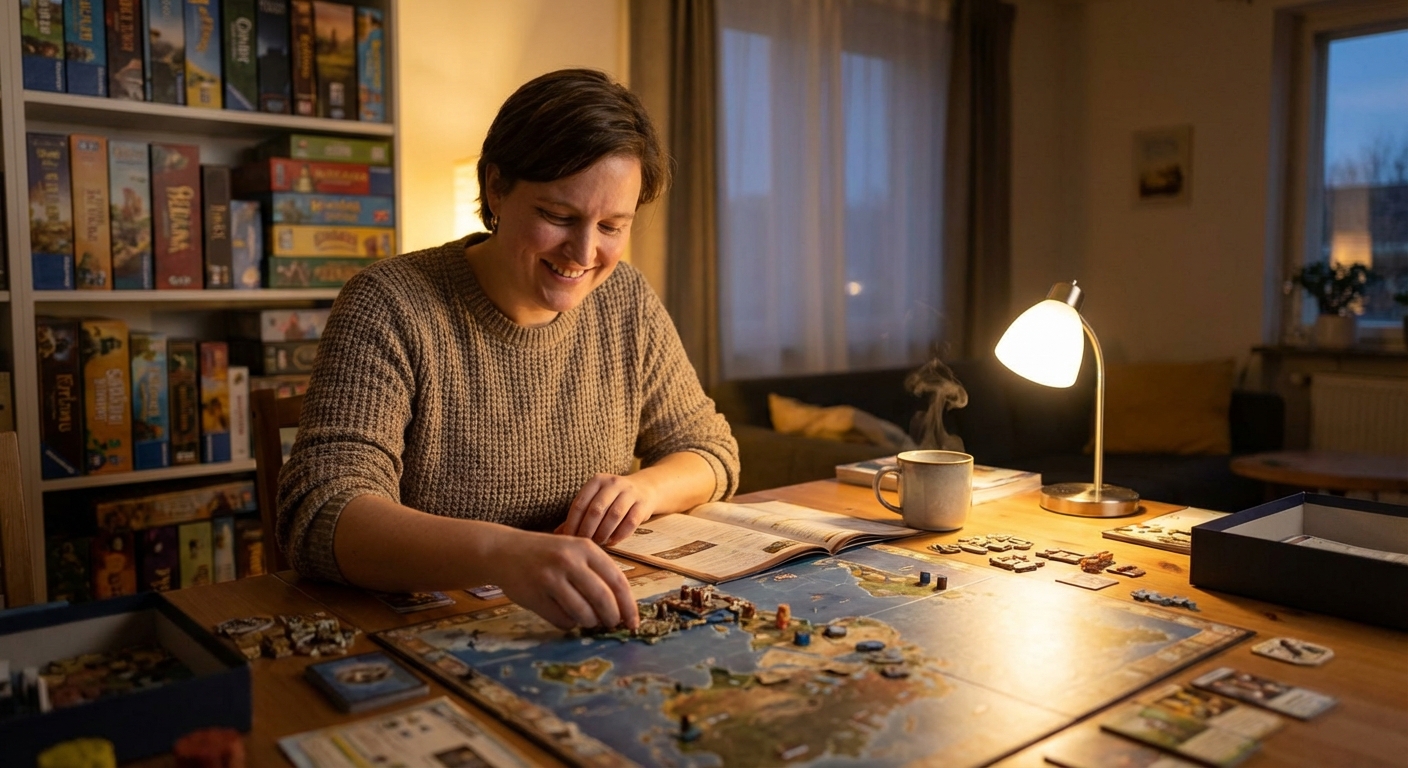
Ask five solo gamers what they want from a session and you’ll get five different answers:
Solo Gaming Isn’t One Thing
- A razor-sharp puzzle
- A sprawling narrative
- A tense roguelike beatdown
- A chill engine builder to unwind with
If you keep bouncing off solo play, odds are you’re mismatching your mood with your game type.
Let’s break solo experiences into four archetypes—Crunch, Story, Roguelike, and Zen Engine—then walk through what each demands in terms of strategy, components, and patience.
Archetype 1: The Crunch Puzzle
You want: To burn neurons, not tell stories.
Examples: Spirit Island, Lisboa, On Mars, Under Falling Skies, Hadrian’s Wall
What It Feels Like Solo
You’re solving a multi-variable optimization problem under brutal constraints. Multiplayer interaction is almost irrelevant; it’s all about whether you can build and execute a clean plan.
Strategic Mindset
- Plan in arcs, not turns: early setup, midgame inflection, endgame scoring.
- Accept that perfect play is impossible; look for “good enough” heuristics.
- Use solo to run controlled experiments: same map, new opening line.
- One night you spam fear and soft control
- Next night you go hard offense and see how the map reacts
Example in Spirit Island:
Component Priorities
Crunch games bring overhead. For solo sanity, prioritize:
- Readable boards: Clear zones and track segmentation
- Distinct tokens: Different shapes/colors for different status markers
- Player aids: Turn order, icon guides, and reminder cards are mandatory
If the graphic design is muddy, you’ll spend more time parsing the board than thinking about strategy.
Pros & Cons
Pros:
- Immense depth and replayability
- Satisfying post-game analysis (“I lost on turn 5, I just didn’t know it yet”)
- Mentally exhausting after a long day
- Long setup/teardown can kill impulse plays
Cons:
Best for: Evenings where you want to sweat, not relax.
Archetype 2: The Story Machine
You want: To inhabit a world, make choices, and see what happens.
Examples: Nemo’s War, Final Girl, Gloomhaven/Frosthaven, ISS Vanguard, Sleeping Gods
What It Feels Like Solo
You’re reading an interactive novel with dice, cards, and maps. You forgive mechanical rough edges because the narrative payoff is high.
Strategic Mindset
- Play in character: let your motive, hero, or crew personality inform your risk tolerance.
- Don’t chase “perfect outcomes”; chase interesting stories.
- Embrace variance: the bad roll that maims your crew is also tonight’s tale.
- A Science motive might lead you to avoid combat even when it’s tempting.
Example in Nemo’s War:
Component Priorities
Immersion dies when components fight you.
You want:
- Thematic art that supports reading the board as a story
- Logically organized decks (events, encounters, items clearly separated)
- Robust storage: campaigns demand save systems that survive weeks between sessions
Bad iconography or flimsy cards break immersion faster in solo because all cognitive load is on you.
Pros & Cons
Pros:
- Emotional highs and lows, not just scores
- Great sense of continuity across sessions
- Rules overhead can be heavy
- Story pacing can be uneven; some sessions are pure admin
Cons:
Best for: Nights when you’d otherwise binge a show but want to participate, not just consume.
Archetype 3: The Roguelike Gauntlet
You want: A fast, mean fight you’ll probably lose—and immediately rematch.
Examples: Under Falling Skies, Final Girl, Hostage Negotiator, Warp’s Edge, One Deck Dungeon
What It Feels Like Solo
Short, sharp runs with escalating stakes. Your goal is incremental mastery, not consistent victory.
Strategic Mindset
- Think in terms of runs, not sessions: 2–4 plays back-to-back.
- Learn the probability texture: how often do bad chains occur, and how do you plan for them?
- Identify key inflection decisions: one or two choices per run that determine success more than micro-optimizations.
- When to commit to rescuing victims vs. sprinting to damage the killer.
Example in Final Girl:
Component Priorities
Roguelikes live or die on friction.
Look for:
- Snappy setup: 5–10 minutes max
- Durable cards/dice: they’ll see a lot of action
- Modular expansions that add variety without exploding complexity
Avoid games where each run requires re-sorting 400 cards.
Pros & Cons
Pros:
- Perfect for limited time
- Highly addictive “just one more try” loop
- Can feel repetitive if content variety is low
- Brutal losses may frustrate if you crave steady progress
Cons:
Best for: Weeknights, tight windows, or when you want a focused challenge hit.
Archetype 4: The Zen Engine Builder
You want: Flow. Satisfying combos. Light tension, heavy dopamine.
Examples: Wingspan, Terraforming Mars with a clean solo variant, Cascadia, Ark Nova (on easier solo settings)
What It Feels Like Solo
You’re building a machine and watching it hum. Winning matters, but the real pleasure is in seeing synergies click.
Strategic Mindset
- Optimize, but don’t agonize: shoot for good lines, not perfect ones.
- Treat solo constraints (turn timer, target score) as soft boundaries, not brutal enemies.
- Experiment with weird builds you’d never try in a competitive group.
- Force yourself into a food-starved predator build, just to see if it flies.
Example in Wingspan solo:
Component Priorities
These games often shine in production.
Useful features:
- Pleasant tactile bits: nice tokens, eggs, or tiles that make play feel luxurious
- Clear dual-purpose cards: text and icons both legible at a glance
- Low-clutter solo modes: simple bots or beat-the-score setups
If the solo opponent is fussy, consider ditching it and playing sandbox-style with self-imposed goals.
Pros & Cons
Pros:
- Relaxing but still engaging
- Great for ending the day on a high note
- Low-stakes tension might bore hardcore challenge seekers
- Poor solo modes can feel completely toothless
Cons:
Best for: Evenings when your brain is fried but you still want cardboard in your hands.
Matching Mood to Game: A Simple Decision Matrix
Ask yourself three questions before pulling a box:
How much brain do I have left?
- A lot → Crunch or Roguelike - Medium → Zen Engine - Low, but I want feels → Story Machine
How much time do I realistically have?
- 20–40 min → Roguelike or small Zen - 60–90 min → Crunch medium-weight, Story intro - 2+ hours → Big Crunch or heavy Story campaign
Do I care about narrative tonight?
- Yes → Story Machine or narrative-leaning Roguelike - No → Pure Crunch or Zen Engine
This takes 30 seconds, and it will dramatically increase your hit rate of “that was the right game for tonight.”
Hybrid Designs: When Categories Collide
Some of the best solo games mix archetypes:
- Nemo’s War: Story Machine + Crunch + Roguelike
- Final Girl: Story Machine + Roguelike
- Ark Nova: Crunch + Zen Engine
- Decide which part you care about most
- Forgive weaknesses in the secondary style if the primary one sings
When evaluating hybrids:
If you want intense puzzle play and pick Nemo’s War for the narrative, don’t complain that the dice occasionally ruin your “perfect” plan. That’s the price of the story.
Component and Design Red Flags for Your Preferences
Depending on what you’re after, certain features are instant warning signs.
If you want Crunch
Avoid:
- Excessive random events that blow up long-term planning
- Overly cute AI that behaves “like a player” but takes ages to run
If you want Story
Avoid:
- Dry point-salad solos where narrative is pure headcanon
- Games with heavy text but terrible editing or tiny fonts
If you want Roguelike
Avoid:
- Setup that’s longer than a single run
- Campaign systems that punish losing with extra grind
If you want Zen Engine
Avoid:
- Bots that require you to track 3–4 resources and a full tableau for them
- Victory conditions that feel like exams instead of vibes
Be picky. Shelf space and time are premium resources.
Final Thoughts: Tune Your Shelf to Your Brain, Not the Hype
The hobby loves hype cycles. Every year has “the” big co-op, “the” heavy Euro, “the” insane campaign.
Solo play cuts through that. When it’s just you and the game, marketing disappears and fit matters.
Curate a solo collection where:
- You have at least one game in each archetype that you genuinely love
- Setup time matches how often you’ll realistically play it
- Component quality and solo design respect your cognitive load
Then, when you ask, “What do I feel like tonight?” your shelf will actually have an answer.
And solo gaming stops being a compromise.
It becomes the sharpest, most honest way to enjoy the hobby.