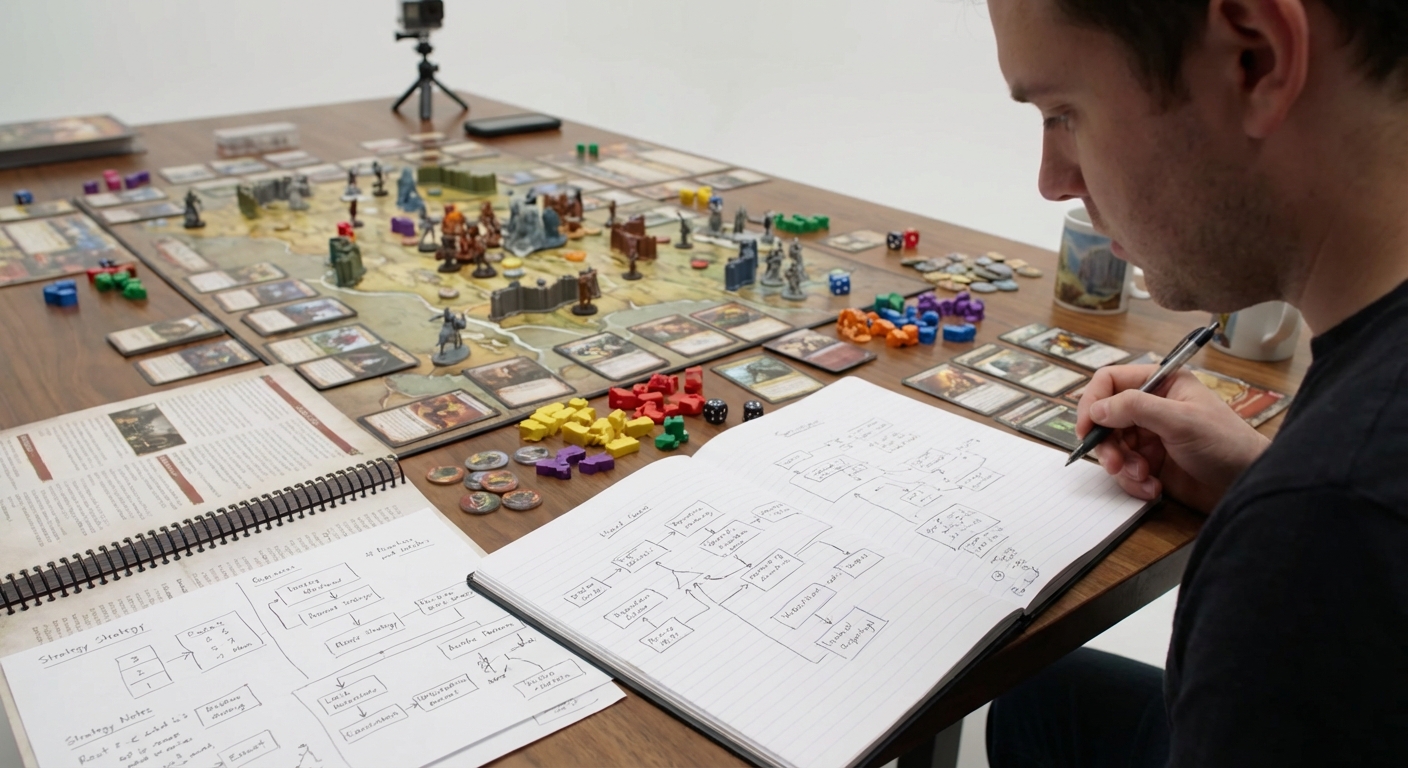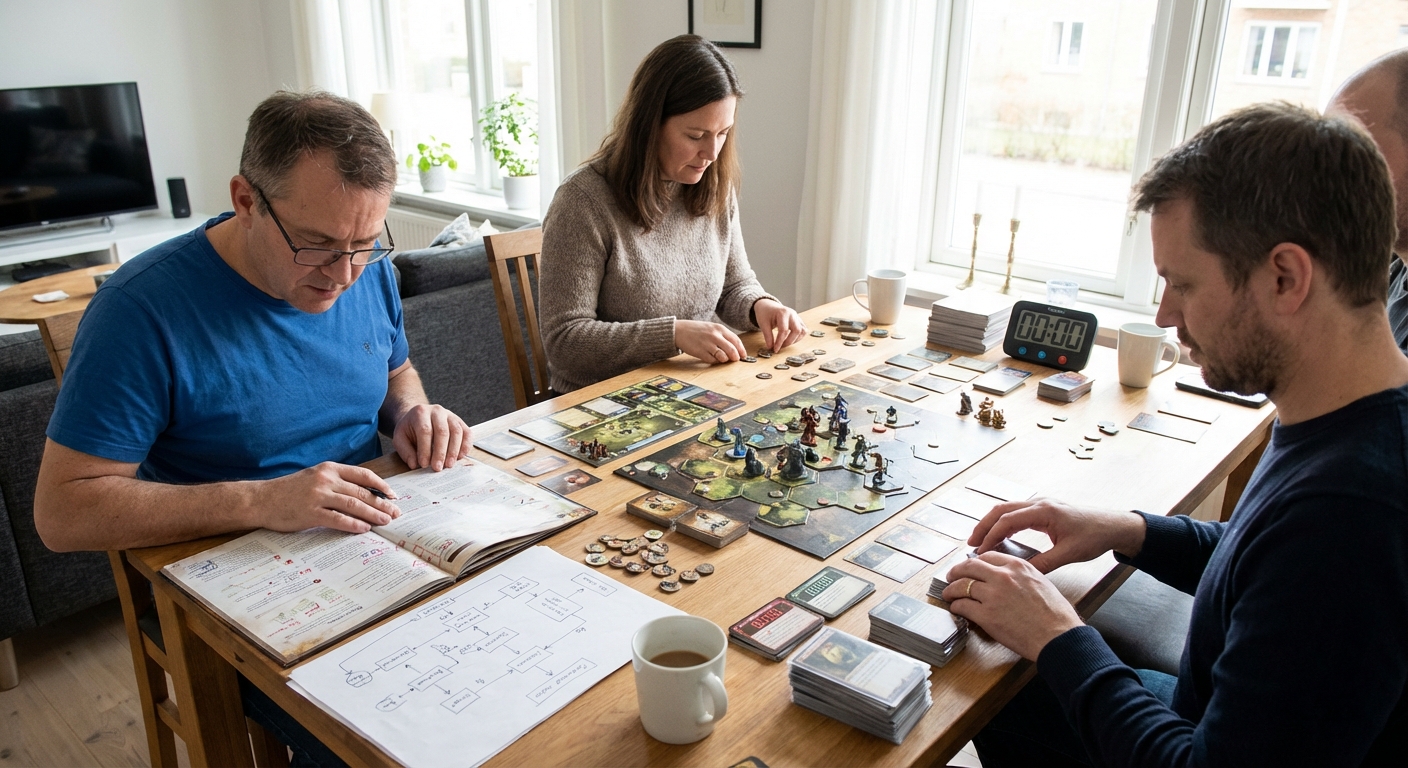
The "first play auto‑loss" is so accepted in board gaming that people joke about it. New rules, new systems, new icons—of course the experienced player wins.
You Don’t Have to Get Crushed on Game One
That doesn’t have to be your reality.
You can approach any new game with a strategy‑guide mindset, even if no guide exists yet. With a bit of structured thinking, you can avoid the worst traps and be competitive from round one.
Here’s a reusable framework to build a mini strategy guide in your head the first time you sit down at a new table.
Step 1: Read the Game Like a Designer, Not a Victim
Before you even start, scan the rulebook and components with three questions in mind:
How do we score?
Don’t just note the scoring methods—rank them by: - Repeatable vs. one‑off - Early vs. late game accessibility
What’s scarce?
Look for: - Limited spaces or tracks - Tight currencies (money, actions, cards) - Turn order manipulation
What feels overproduced?
If a track, token, or component looks lavish, odds are it’s important. Designers don’t spend budget on things they expect you to ignore.
You’ve just built the skeleton of your mental strategy guide.
Step 2: Map the Core Loop in One Sentence
Every good strategy guide starts with the core loop: the repeated pattern of actions that actually wins games.
Example structures:
- "Turn actions into resources, resources into upgrades, upgrades into points."
- "Push units to key spaces, gain control, convert control into scoring triggers."
In your head (or on a notepad), write:
"In this game, I mostly turn X into Y so I can get Z."
If you can’t fill in those blanks before the first round ends, that’s your first priority.
Step 3: Draft a Hypothetical Game Plan in 60 Seconds
Right after setup and teach, force yourself to make a rough plan, even if you’re likely wrong.
Ask:
- Am I aiming to be fast (tempo/aggression) or rich (engine/economy)?
- Which part of the board or which systems look the most fruitful?
- Is there a visible multiplier (tracks, tags, sets) I can lean into?
Jot a 1–2 sentence plan:
"I’m going to build income through X, then pivot to scoring Y once I hit threshold Z."
Congratulations: that’s your version 0.1 strategy guide.
Step 4: Use Component Layout as a Strategic Compass
Component quality is more than aesthetics; it’s guidance.
Look for:
- Tracks front and center on the board – often core to scoring or tempo.
- Highlight colors or icons – designer signposts for crucial systems.
- Dual‑layer player boards – usually where your engine lives.
If an area is beautiful, big, and deeply iconographied, assume it’s a major decision hub. Strategy guides always spend paragraphs there; you can focus your learning there on play one.
If key information is hidden in the margins (tiny bonus icons, obscure card text), mentally flag these as:
- "High leverage if mastered"
- …but easy to miss on first play. Don’t lean too hard on them early.
Step 5: Borrow Generic Euro and Tactical Heuristics
When no dedicated strategy guide exists, you can borrow evergreen heuristics depending on the game’s nature.
If It’s a Euro / Engine Builder
Default to:
- Build economy first, score later.
- Avoid tiny early points that cost major actions.
- Aim for at least one clear multiplier (track, tag, set type) to focus on.
Common early mistakes to dodge:
- Splitting attention across too many systems
- Over‑investing in late‑game scoring when you have no way to reach it
If It’s Tactical / Conflict‑Heavy
Default to:
- Don’t expose yourself as obvious leader too early.
- Fight for positioning and tempo, not just raw power.
- Preserve hand flexibility—don’t blow your entire combo for minor gains.
Early mistakes to dodge:
- Over‑committing units to low‑value fights
- Making enemies out of everyone at once
These generic rules won’t make you a master—but they’ll prevent bad, game‑losing blunders.
Step 6: Watch for Early Red Flags (So You Can Adjust)
Pro strategy guides always highlight "If this is happening, you’re in trouble" scenarios. Build your own as you play.
During the first half of your first game, ask:
- Am I constantly resource‑starved in a way others aren’t?
- Am I taking more actions that don’t clearly progress a long‑term goal?
- Do I understand how at least one opponent is trying to win?
If the answers are bad, simplify your plan:
- Abandon side projects
- Focus everything on one or two clear scoring methods
Step 7: Document a Mini Post‑Game Strategy Guide
The game ends, you lose (or maybe you don’t). Now you cash in your experience.
Spend 3–5 minutes capturing:
What clearly worked for the winner(s)
One early mistake you won’t repeat
One system you misunderstood but now grasp
Turn that into a short, structured note:
- Core loop summary
- Best early priorities
- Biggest trap you fell into
You’ve just written the V1 of a real strategy guide—small, but already better than going in blind next time.
Pros and Cons of Playing This Way
Pros:
- Way less “lost” feeling on first plays
- Faster path to meaningful decisions and satisfying combos
- You become the person who can teach others the why, not just the rules
Cons:
- Slightly higher cognitive load on your first game
- Can reduce the sense of “pure discovery” if you prefer wandering blindly
- You may start noticing just how punishing some designs are for new players
Turning Yourself into a Walking Strategy Guide
You don’t need MeepleByte‑worthy 3,000‑word PDFs for every box on your shelf. You just need a repeatable way to see the game behind the game quickly.
Next time you crack the shrink on a new title, run through this framework. Treat the first play as the raw data for your personal strategy guide. After two or three plays, you’ll have more insight than some published guides—and you’ll stop treating “I’ve never played before” as automatic permission to lose.