Dedicated gamers obsess over dual-layer player boards and metal coins, then happily play party games on flimsy cards and dried-out markers. That double standard needs to die.
You’re Not Crazy: Most Party Game Production Is Trash
If you’re going to bring a game to half your social events, it deserves premium production. The good news: a new wave of party titles actually respects your hands and your table.
This guide focuses on party games where component design and physical ergonomics truly matter—and calls out where publishers cut corners.
We’ll look at:
- So Clover!
- Monikers
- Wavelength
- Decrypto
- Just One
- A few honorable (and dishonorable) mentions
So Clover! – The Gold Standard of Tactile Party Design
Publisher: Repos Production
Players: 3–6
Component Highlights
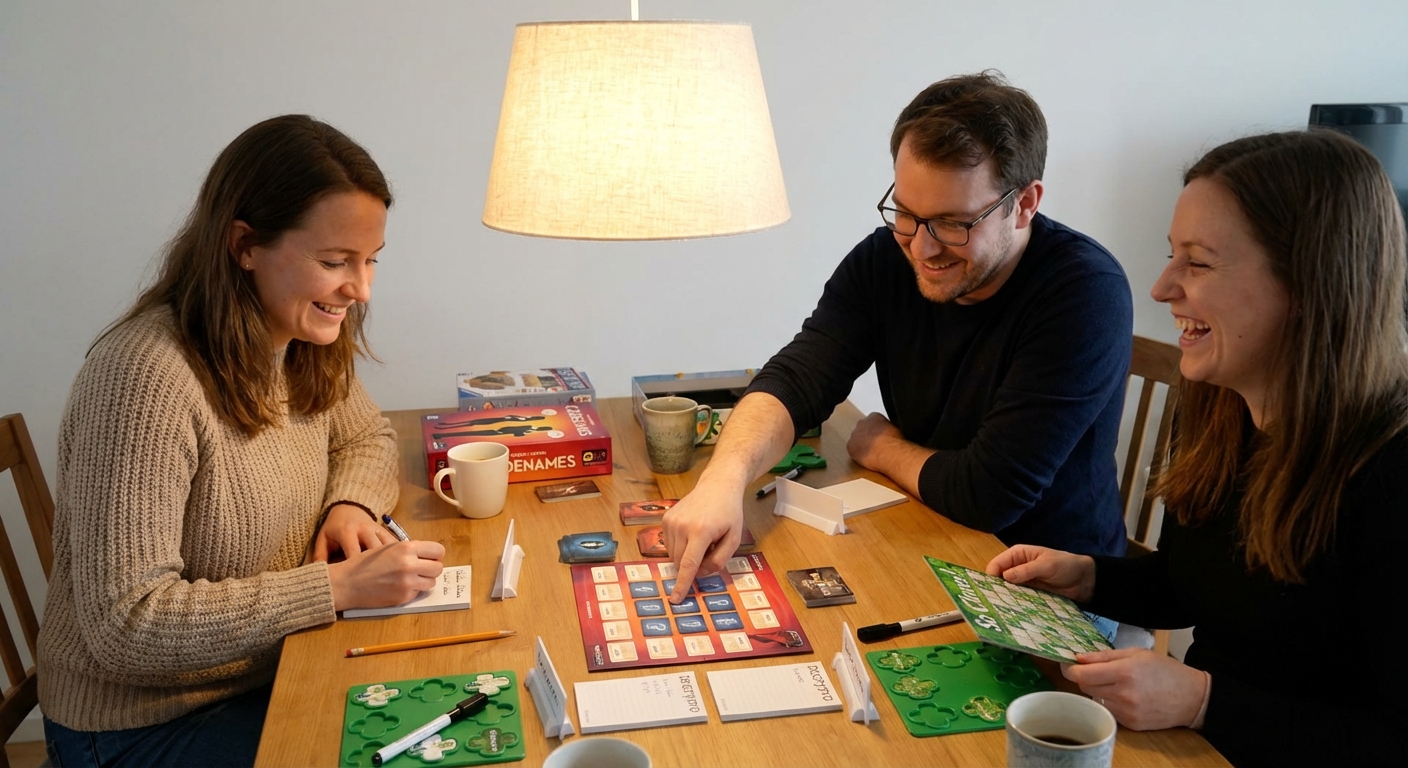
- Clover Boards: Thick, textured plastic clovers that feel almost indestructible. The recessed slots hold tiles perfectly: snug, but not annoying.
- Word Tiles: Small, square cardboard tiles with clear typography on both sides. Matte finish avoids glare.
- Markers: Serviceable, but improvable, fine-tip dry-erase markers.
Why It Matters in Play
- The clovers stay put when the table gets animated; no accidental board nudges or misalignments.
- Removing and reinserting tiles is smooth; no repeated wrestling with too-tight cuts.
- The boards naturally orient players into a shared focus point, helping group discussion.
Upgrade Thoughts
- Swap in higher quality wet-erase markers. Staedtler Lumocolor or similar make a shocking difference in legibility and cleanup.
- Consider color-coding tiles by set if you mix expansions later; right now, everything is visually identical, which is fine until you want curated difficulty.
Verdict: If you want one example of party-game component design done right in 2020s, this is it.
Monikers – Excellent Cards, Minimal Gimmickry
Publisher: Palm Court
Players: 4–20+
Component Highlights
- Cards: Thick, linen-finished cards with sharp, saturated printing and clean typography.
- Art: Modern, stylish, and distinctive without being noisy.
- Box: Functional two-part box, ample space for expansions.
Why It Matters in Play
- Cards get shuffled, thrown, grabbed, and bent for hours. Monikers holds up to abuse better than most party titles.
- Distinct illustration style helps quick recall: you don’t just remember names, you remember the art associated with them.
Upgrade Thoughts
- Sleeving is optional; the finish is durable, but if you host conventions or bars, sleeves might be worth it.
- A card divider system or labeled pockets would significantly improve organization once you own multiple expansions.
Verdict: Monikers respects your table. No gimmicky components, just consistently high-quality cards designed for real-life chaos.
Wavelength – Toy-Like Centerpiece with Real Design
Publisher: CMYK
Players: 2–12
Component Highlights
- Dial Device: A chunky plastic contraption with rotating dial, sliding screen, and satisfying “click” feedback.
- Prompt Cards: Large, thick cards with high-contrast printing.
- Insert: Surprisingly functional—everything nests in the box properly.
Why It Matters in Play
- The dial is instantly understandable to new players; table presence does half the rules teach for you.
- Tactile feedback on the wheel makes it easy to set precise positions without overshooting, even when you’re not looking directly at it.
Component Weaknesses
- The box is larger than necessary, which is annoying on packed shelves or when traveling.
- Long-term, plastic hinges or sliding mechanisms can loosen—treat it like a game component, not an actual toy.
Upgrade Thoughts
- A travel version with a more compact, slightly less flamboyant dial would be an instant-buy for many hobbyists.
- Some groups house-rule using a smartphone timer app instead of fiddling with the included markers for score tracking.
Verdict: Wavelength proves that a party game can justify a big table toy when it’s actually well-engineered.
Decrypto – Strong Screens, Slightly Generic Everything Else
Publisher: Le Scorpion Masqué
Players: 3–8
Component Highlights
- Decoder Screens: Heavy cardboard with slots for word cards. Great table presence.
- Word Cards: Thick, double-sided, clearly printed.
- Clue Sheets: The right size and texture for repeated writing.
Why It Matters in Play
- The screens create clear team zones and physical separation of information. Everyone knows where to look.
- The angle and opacity of the screens are just right to hide words from opponents while being readable to your team.
Component Weaknesses
- The word font is a bit small for low-light or distance, especially for older eyes.
- Score tokens are generic; you’ll likely upgrade or track scores elsewhere.
Upgrade Thoughts
- Use thicker, darker pens for the clue sheets—stock pens can be too light for quick reading at a distance.
- Print or buy a dedicated tracking sheet for opponent clues; the included pads work, but they’re not optimized for long-term deduction notes.
Verdict: Not luxurious, but smart and functional. A classic case of components that know their job and do it well.
Just One – Great Design, Mediocre Pens
Publisher: Repos Production
Players: 3–7
Component Highlights
- Plastic Easels: Sturdy, standable, and easy to wipe. The angled design is genuinely useful.
- Word Cards: Card stock is decent, but very vanilla.
- Markers: The usual: cheap dry-erase that dry out earlier than you’d like.
Why It Matters in Play
- Having each player’s clue on its own little easel makes cancellation checks snappy.
- The vertical orientation improves visibility around a crowded table.
Component Weaknesses
- Stock markers are the bottleneck: faint, inconsistent, and prone to ghosting on the plastic.
Upgrade Thoughts
- Replace with quality fine-tip dry-erase markers and never look back. This is the highest-impact, lowest-cost upgrade in party-gaming.
- If you play a lot, sleeve the word cards—not for protection, but so you can add sticky flags for “skip these, they’re boring/awkward” without ruining them.
Verdict: The core physical design is smart; it’s just held back by budget markers and generic cards.
Honorable Mentions and Caution Flags
Insider / Werewords – Tiny Packages, Functional Production
- Small decks, simple role cards, maybe a token or two. Card quality is usually fine.
- These games live or die on clarity of iconography. Check that your edition has bold, intuitive role art.
These are perfect for EDC (everyday carry) in a bag or jacket.
Codenames – Serviceable but Dated
- Pure cards and a key tile. Everything works, but after years of use, the minimal production shows its age.
- If you play often, invest in a large-font fan-made version or sleeve heavily used sets.
Cheap Knock-Off Laughing Games – Avoid on Component Feel Alone
The market is flooded with low-effort, single-idea boxes with:
- ultra-thin card stock;
- misaligned cutting;
- dreadful readability in low light.
If your group plays hard and often, these games will die fast and look gross while doing it.
How to Shop for Party Games Like a Component Snob
When you’re evaluating a new party game in person, do this:
- Shake the box. If it sounds like a maraca, components are probably loose and unprotected.
- Check fonts at distance. Hold a random card at arm’s length under realistic lighting. If you have to squint, pass.
- Touch the most-used component. Cards, markers, devices—how do they feel in hand? Does it feel like something you’ll abuse 100 times?
- Look for smart inserts. Good publishers assume you’ll re-box in a hurry; if the insert is trash, the game will slowly devolve into baggy chaos.
For online purchases, read actual hobbyist comments about cardstock and ergonomics, not just “this game was fun.”
When to Invest in Bling and When to Save
Worth upgrading:
- Markers (So Clover!, Just One, any dry-erase game).
- Score tracking (custom boards, apps, or tokens for Decrypto, Monikers).
- Storage (deck boxes, dividers, or foam for large collections like Monikers).
Usually not worth upgrading:
- Premium sleeves for low-use party decks unless you’re running pubs or events.
- 3D-printed gimmicks that add fiddliness (e.g., fancy Codenames stands that make laying out 25 cards slower).
Final Word: Treat Your Party Games Like Workhorses
Your party games see more plays, more spills, more non-gamer handling than almost anything else on your shelf. They should be tough and comfortable.
Demand good components. Reward publishers that get ergonomics right (So Clover!, Wavelength, Monikers). Patch the weak spots yourself with smarter markers, sleeves, and organizers.
If you’re going to evangelize the hobby through party titles, at least make sure the games you slam on the table don’t feel like afterthoughts. They should look and feel as sharp as the jokes and strategies they inspire.